
I was sitting in a boardroom on a Thursday afternoon last year — one of those glass-and-hardwood offices where everyone around the table has a credential framed on the wall — about to pitch a scope larger than anything I'd done in the first decade of my career, and the voice was there. Clear as anything. Who exactly do you think you are?
Twenty-five years in the industry. Projects on every scale. More screw-ups behind me than most of the people in that room will ever have to navigate. And there it was anyway, right on schedule, reminding me that I might be in over my head.
I pitched the work. We got it. But I want to talk about that voice, because I hear from business owners at every stage of growth who think they're the only one having that conversation with themselves, and the silence around it is actually costing people decisions.
The Voice Doesn't Retire When You Do
The assumption most tradespeople make when they're starting out is that the feeling goes away. More jobs behind you, more experience, more years of not having things fall apart catastrophically, and eventually the self-doubt fades out. That was my assumption too, for a long time.
What actually happens is the voice stays. What changes is the script.
Early on it sounds like "I don't know enough to be doing this." That's the version you have when you're running your first crew and quietly terrified someone will ask a question you can't answer. A few years in it shifts: "The people I'm trying to impress know things I don't." Later still it becomes something more insidious: "My results so far were largely circumstance and eventually someone is going to figure that out." Different pitch, same paralysis if you let it drive.
I've talked to contractors who've been running their businesses for fifteen, twenty years who still have versions of this conversation. Not every week, not crippling them, but present. The guy who's landed every contract he's gone after for a decade still second-guesses himself before a pitch he hasn't done before. The owner who's built a solid team and a real company still hears the whisper before she walks into a room full of developers. This is not a character flaw. It's not evidence of weakness. It's apparently just what serious ambition feels like from the inside.
When It Gets Loudest
What I've noticed over the years is a pattern. The feeling doesn't come randomly. It shows up in concentrated form before specific kinds of moments.
Before you pitch the largest project you've ever bid. Before you hire your first project manager and stop being the person who does everything. Before you raise your rates above what feels like a comfortable number and have to hold that price without apologizing for it. Before you give a talk to a room of people who've been in the industry longer than you. Before any move with real stakes and real uncertainty.
"The voice is loudest right before the things that matter most. If you're waiting for it to quiet down before you act, you're going to be waiting a long time."
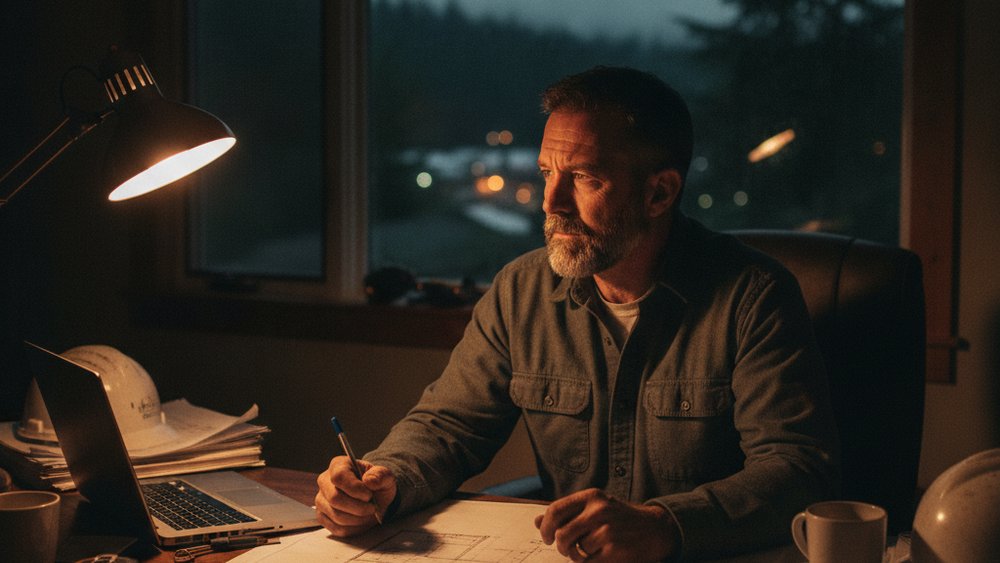
The interesting thing is that this pattern is actually useful if you know to look for it. The voice is loudest right before the things that matter most. If you're waiting for it to quiet down before you act, you're going to be waiting a long time, and all the things you're waiting on are probably the most important decisions your business is facing.
The financial pressure that makes you doubt your pricing and the self-doubt about whether you're worth what you charge are often the same conversation. Both of them whisper that you're going to be found out. Neither of them is giving you reliable information.
What the Builders You Respect Actually Feel
I'll tell you what I've heard in private from people whose businesses I admire. The contractor who's been running a forty-person operation for twenty-two years and who looks, from every angle, like someone who has fully figured out what he's doing. The woman who built one of the more respected renovation companies in her region and whose work gets written about in trade publications. The guy who sold a portion of his company at a number most small contractors would consider a fantasy.
Every single one of them has told me some version of "I still have the conversation." Not publicly. Not in the room. But in the car on the way to a pitch, or the night before a decision that's going to change the shape of the company, or when they're looking at a set of numbers that suggest they should make a move they've never made before. The voice is still there.
What they didn't do is let it vote. They felt the doubt, acknowledged it, and did the work anyway. They walked into the room with the voice still running and did what needed doing. The difference between them and the people who stay small isn't confidence in the Hollywood sense, some effortless unflappable belief in themselves. It's the willingness to move while the doubt is present.
"The voice doesn't retire when you do. What changes is your ability to notice it without letting it be the last word."
That distinction matters enormously. Waiting to feel ready is a plan that does not produce results. The people who've built something worth building almost universally describe starting before they felt ready, and feeling more capable on the other side of it, not before.
The Mistake of Treating the Feeling as Evidence
Here's where I got it wrong for a long time: I treated the feeling as information about my actual competence. If I felt out of my depth, I must be out of my depth. If the voice was telling me I wasn't ready, the voice must have access to data I didn't.
It doesn't. The feeling of not being qualified enough, experienced enough, or smart enough for the next step is a feeling. It is not a performance review. It has, in my experience, almost no reliable relationship to actual capability. Some of the most underprepared people I've met in this industry radiate confidence. Some of the most competent people I know hedge every statement they make about themselves and wait too long on decisions that were obviously right.
The pattern I've seen bear out over many years of running a trades business is this: the self-doubt is loudest at the moments when you're at the edge of what you've already proven you can do. That's the edge of growth. If you're not occasionally sitting with that discomfort, you're probably not moving. Staying comfortable is its own kind of risk, just a slower and quieter one than the fear of failing at something new.
What actually differentiates you from every other contractor is rarely about the scope of what you've already done. It's about the willingness to operate honestly at the edge of what you know.
How I Work With It Now
I'm not going to tell you I've solved this. I haven't. The voice still shows up before the big moves. What I've done is change how I respond to it.
First: I notice it without treating it as a stop sign. When the doubt shows up, I've learned to recognize it as the feeling of being about to do something that matters, not evidence that I'm the wrong person to do it. That reframe took years of getting it backwards before it became automatic.
Second: I've stopped waiting for certainty. Construction taught me this better than any business book. There is no version of a project where all the variables are resolved before you break ground. You plan, you prepare, you bring in the right people, and then you start and you solve what comes up. The businesses that wait for certainty on the big decisions either move very slowly or stay small by default.
Third: I talk to people who will be honest with me. Not cheerleaders, not coaches who just validate every instinct, but people who will tell me when they think I'm making a mistake and who have enough experience that their perspective is actually worth weighing. The moment I realized I was the bottleneck in my own business was a conversation, not a spreadsheet. Someone outside my head said the thing that needed saying and I was in a position to hear it because I'd been honest about what was actually going on.
That's harder to build than a strategy. But it's more valuable.
The Bottom Line
The imposter syndrome conversation doesn't end. If you're waiting for it to stop before you take the next step in your business, you're building a plan around a thing that isn't going to happen. The people who build real companies aren't the ones who don't feel the doubt. They're the ones who've stopped letting it be the deciding vote.
Notice the feeling. Ask yourself whether it's telling you something actionable or just making noise. Then do the thing anyway, because the work on the other side of the discomfort is almost always what needed doing.
If the mindset side of running a trades business is something you're working through — the self-doubt before big moves, the patterns that keep you stuck, the gap between what you know to do and actually doing it — that's exactly the kind of thing I work through with owners in my construction business coaching. The strategy and the human who has to execute it are the same problem.
Get The Builder's Playbook in your inbox
A short note from Eddy with a link to the week's post — one email a week, every Thursday, nothing else.
No spam. Unsubscribe with one click any time. Privacy policy.
This site is protected by reCAPTCHA and the Google Privacy Policy and Terms of Service apply.