
I added a second crew before I was ready. The first crew was busy, the phone was ringing, and the math looked simple: another truck, another lead hand, roughly another set of project revenues to match the overhead. Three months in, I was working sixteen-hour days managing two operations that both needed constant input from me, making less margin than I'd been making with one crew, and genuinely struggling to remember which site had which problem. The revenue had gone up. Everything else had gotten worse.
That was my first hands-on lesson in what scaling a trades business without systems actually costs, and it took me longer than it should have to understand what I'd actually done wrong.
The Multiplication Problem
The most common mistake I see trades business owners make is treating growth as the solution to their operational problems rather than as the multiplier of them. The business is disorganized, the margins are thin, the owner is doing too much themselves, and the mental model is that more revenue will create the breathing room to fix all of that. So they take on more work, hire faster than they should, and find themselves running a larger and more expensive version of the same problem.
What scaling actually does is multiply whatever conditions exist in the business at the time of scaling. If your current operation is clean — clear processes, defined roles, crew leads who can make decisions without you — then scaling brings more of that. If your current operation runs on the owner's personal knowledge, judgment, and daily presence, then scaling just means the owner needs to be in more places at once, and that's not a business model. That's a treadmill with a higher speed setting.
Why most small contractors stay small is usually this exact dynamic. Not lack of ambition, not lack of talent, not lack of market opportunity. The operation was never built to run without the owner at the centre of everything, so growth just means more weight on the same set of shoulders, and eventually those shoulders give out or the quality degrades enough that the growth stalls on its own.
The Two-Week Test
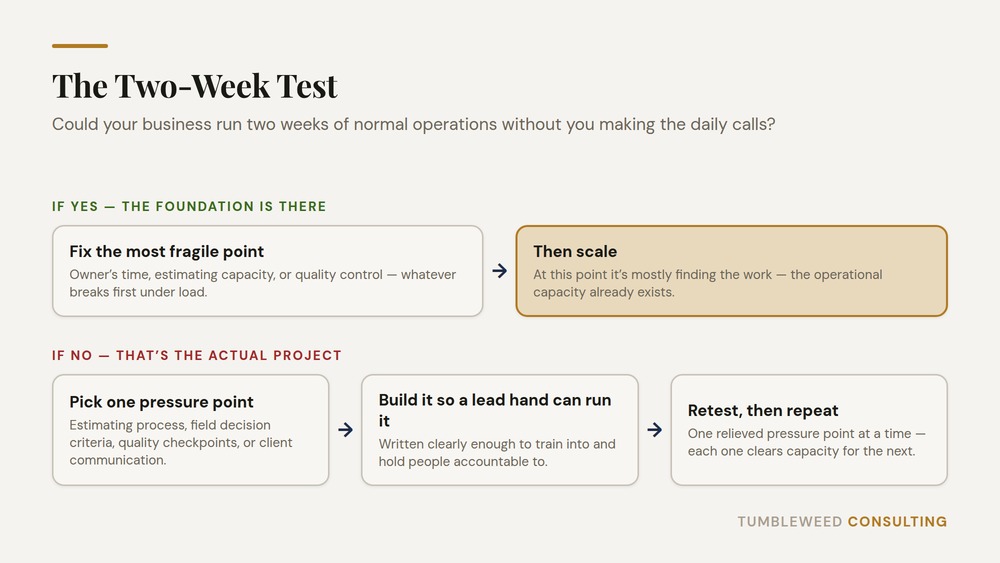
There's a question I ask every trades owner who tells me they want to scale: could your business run for two weeks without you making daily decisions?
Not two weeks without any leadership. Not two weeks with a skeleton crew coasting through quiet time. Two weeks of normal operations — normal project load, normal client communication, normal problem-solving in the field — without you personally being the person who makes the calls or holds the answers. If the answer is yes, you have the foundation to scale. If the answer is no, that's the actual project, and adding a crew before you complete it is going to make it harder, not easier.
Most owners give me an honest "no," and then they tell me why: the estimating lives in their head, the relationships with the suppliers are theirs, the crew comes to them with every question because there's no defined process for how decisions get made, the quality check happens because they personally walk the site at key milestones. If it lives in someone's head, it can't scale — not because the person isn't good at what they do, but because there's only one of them and you can't hire a second one.
The two-week test isn't about building a business you don't show up to. It's about building a business where your absence doesn't cause the machine to stop. There's a meaningful difference between a business that needs your leadership and vision and a business that needs you to personally answer every field question and approve every supplier call. The first is healthy. The second is a constraint that limits how big the business can ever get.
"You're not trying to remove yourself from the business. You're trying to remove yourself as the bottleneck inside it."
What Actually Needs to Be Documented
The word "documentation" makes most trades guys' eyes glaze over because they think it means writing a policy manual nobody reads. That's not what I mean. What I mean is capturing how good decisions actually get made in your operation, so that someone other than you can make them correctly.
That usually comes down to a few specific things. How does a job get estimated — what's the process, what are the margin targets, what gets included and excluded in the standard scope? How does the crew handle a situation that falls outside the plan — who has the authority to make what size of decision, and what gets escalated to the foreman versus what gets a phone call to the office? What does the quality check look like at key project milestones, and who is responsible for it? What does the client communication cadence look like — when do they hear from you, about what, and in what format?
None of those questions requires a thick binder. They require enough clarity that a capable lead hand can operate inside the system without needing to call you every time something comes up. When that clarity exists in written form, even simple and straightforward, you can train people into it, hold people accountable to it, and eventually build a business that runs the same way whether you're on site or not.
Learning to delegate without losing control is closely related to this. Delegation doesn't work when the criteria for decisions are only in your head. It works when the process is clear enough that the person you're delegating to knows what a good decision looks like, and when you've done the work to make sure they've been trained to make it.
The Sequence That Actually Works
The owners who've scaled trades businesses without destroying their margin or their sanity have almost universally followed the same sequence, whether or not they would describe it in these terms.
First, they made the existing operation run correctly. Not perfectly. Correctly. Consistent quality. Predictable client communication. A field team that could handle normal situations without daily owner intervention. A financial picture they understood clearly enough to make decisions from it.
Then they identified which part of the operation would break first under increased load. Usually that's the owner's time, the estimating capacity, or the quality control process. They fixed the most fragile point before adding load to the system.
Then they scaled, which at that point is mostly a matter of finding the work, because the operational capacity is already there. A growth plateau is often the structure telling you it's hit the limit of what it can handle, and the answer isn't to push harder — it's to rebuild the structure before you push.
The reverse sequence — scaling first, systematizing later — can work, but it usually means the owner lives in controlled chaos for an extended period, the quality takes real damage during the growth phase, and the margin compression during that window often means the growth paid for less than it looked like it would.
When You're Already in the Middle of It
Some owners reading this are already in the middle of the problem. They've got more work than their current setup can handle cleanly, the owner is already the bottleneck, and the idea of stopping to document processes feels impossible when the current load is already too high.
I've been there — the bottleneck was me — and it's one of the hardest operational situations to get out of, because the very thing you need to do (step back and build the system) is the thing the current demand won't let you do. There's no perfect answer to this. But there's a practical one: pick the single highest-leverage thing that currently requires your personal input and build a process around that one thing first. Not everything at once. One thing. The estimating template. The field decision criteria. The quality checkpoint at rough-in. Start there, build it into something a lead hand can operate, and get that off your plate. Then do the next one.
"The business doesn't get systematized all at once. It gets systematized one relieved pressure point at a time."
Each pressure point you clear gives you a little more capacity to work on the next, and the compounding runs in your favour for once.
The Bottom Line
Scaling a disorganized business just gives you a larger disorganized business with more overhead and more ways to lose margin. The contractors who grow well are the ones who built the foundation first, who made the current operation run correctly before they made it run bigger. That's not timid. It's the most efficient path to the business actually being worth what you're putting into it.
If you're staring at a growth opportunity and you're not sure whether your operation is ready for it, that uncertainty is worth taking seriously. Working through what needs to be in place before you add the next crew, take on the next market segment, or make the next hire is exactly the kind of thinking I do alongside trades and construction business owners in my construction business coaching.
Quick answers
How do you scale a trades business without burning out?
The key is building the systems and decision-making processes at your current size before adding more crews, clients, or projects. When you document how decisions get made and who makes them, you create a business that can grow without requiring the owner to personally manage every moment of it. Scaling before systematizing just produces a larger, more chaotic version of the same problems.
What systems does a contractor need before scaling?
Before scaling, a contractor needs documented processes for how jobs get estimated and scoped, how crew decisions get made in the field, how client communication is handled, and how quality gets checked at key milestones. The test is whether the operation could run for two weeks without the owner making daily decisions — if it can't, the systems aren't ready to support growth.
Why do construction businesses struggle to scale?
Most construction businesses struggle to scale because the owner built the company around their personal presence and decision-making rather than documented processes. As the business grows, every new project, crew member, or client adds to the owner's load rather than operating inside a defined system. The revenue goes up but the margin and the owner's quality of life go down, until the business becomes unsustainable at its new size.
Get The Builder's Playbook in your inbox
A short note from Eddy with a link to the week's post — one email a week, every Thursday, nothing else.
No spam. Unsubscribe with one click any time. Privacy policy.
This site is protected by reCAPTCHA and the Google Privacy Policy and Terms of Service apply.