
I remember a specific Tuesday, two years into running the business, when a client called at 4:30 in the afternoon asking about a scope change. It was a reasonable question, the kind I'd have answered clearly and confidently at 8 in the morning. Instead I fumbled it. I gave him a number off the top of my head that I hadn't thought through, said I'd confirm it the next day, and then sat in my truck afterward trying to figure out why that had felt so hard.
It hadn't been a hard question. I'd just been answering questions since 6 AM and I had nothing left.
The Cognitive Load Nobody Talks About in Construction
Running a trades or construction business means you're in decision mode from the moment your phone turns on in the morning. Which crew goes to which site. Whether to have the scope creep conversation now or wait until the site meeting. How to handle the sub who didn't show and didn't call. Whether to approve the material substitution the foreman is asking about. What to say to the client who's pushing back on a change order that's clearly legitimate.
Each of these feels small on its own, and none of them feels like it should take much out of you. Together, over a full day, they add up to a toll that's real, even if you can't point to the single decision that used up the last of your clarity.
Decision fatigue is a documented thing. The quality of decisions drops as the number of decisions climbs, no matter how experienced or capable you are. It isn't about willpower or discipline. It's about a limited supply of careful thinking, and every call you make draws on it. Studies have found surgeons make more errors later in the operating schedule and judges grant fewer paroles as the day wears on. The pattern shows up everywhere people make decisions for a living, and I've never seen any reason to think construction owners are exempt.
In practice, that means the decisions you make at 4:30, on the days you've been fielding operational calls since 6 AM, aren't getting your best judgment. They're getting whatever's left over. A lot of what people describe when the owner turns into the bottleneck is exactly this. The owner isn't bad at decisions. They're making the most important ones on the least fuel.
What Gets Consumed Before You Notice
The particular problem in construction is that the decisions drawing on that same limited supply are wildly different in how much they matter. A scheduling adjustment that takes two minutes is drawing from the same account as the people decision you've been putting off. The material substitution approval is competing with the client call that actually needs your full attention.
By the time you sit down to work through the stuff that really counts — a price on a large bid, a conversation about a performance problem on the crew, what kind of work to chase next year — you're doing it from an account that's been in overdraft since mid-morning. Those decisions suffer. Not dramatically, and not in a way you'd notice on any given day, but steadily, over months, in ways that show up in your margin and your people.
Looking back at the day I realized I was the bottleneck, this was a big part of it. I was available for every decision, all day, in real time, and I thought that responsiveness was a strength. What I didn't understand was that being the decision point for everything was exactly how my best thinking got used up before it reached the work that needed it.
Most of the operational decisions coming to me didn't need me. They needed a clear process and someone with the authority to follow it. By making them mine, I was paying a premium in attention for calls that could have been handled for a fraction of that cost.
Batching Is Simpler Than It Sounds
The first change that made a real difference was batching. I used to handle every operational question the moment it arrived: phone buzzes, answer it, back to whatever I was doing, repeat all day. Instead, I started setting aside windows for certain kinds of decisions.
Supply approvals, minor scope clarifications and scheduling adjustments go into a window in the late morning and another in the mid-afternoon. If it isn't urgent in the literal sense of blocking someone right now, it waits for the window. The test for genuinely urgent is whether work will actually stop in the next hour without my input, not whether someone would prefer an answer sooner.
Strategic thinking, people decisions and client relationship conversations go in the morning, before the phone gets busy, before the crew calls start, and before the email backlog makes me feel like I'm already behind. That's when my thinking is sharpest, and that's when those decisions deserve to be made.
"The decisions that shape the business never land in your morning by accident. You protect that time on purpose, or something smaller takes it."
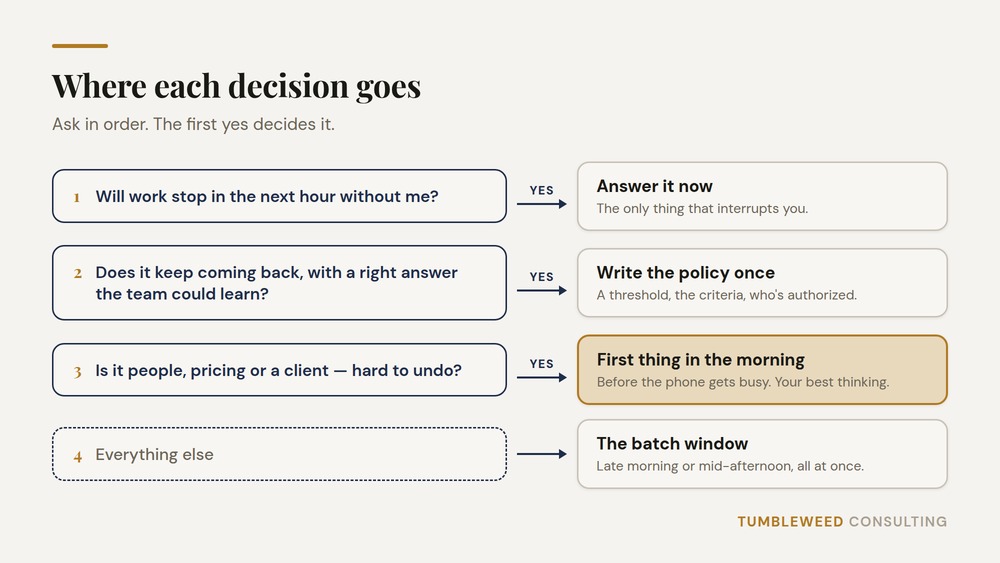
It takes some getting used to on both ends. You have to resist the pull of the open-door, always-available culture most owner-operators build around themselves, and your team has to get used to the idea that not everything gets answered in the moment. The payoff, in the quality of the decisions that matter, is worth the adjustment period.
The Bigger Lever: Eliminating Entire Categories
Batching improves when you make decisions. The bigger change is cutting how many you make at all.
Every recurring operational decision that still lands on you is a sign of a missing policy or a missing process. If your project managers ask you every time whether to approve a material substitution under $500, what they need is a standing policy — here's the threshold, here are the criteria, you're authorized. If the foreman asks how to handle a sub who's running late, there should be a defined escalation path. If a new hire asks what to do about a deficiency a client raised, there should be a standard procedure.
What happens when everything lives in the owner's head is the long version of this problem. The business can't function without the owner on every call, because the policies and processes that would let the team act on their own were never written down. Every recurring judgment call you turn into a policy your team can run without you is a small, permanent gain in the thinking you have left for the decisions that still need you.
Delegation that actually sticks needs exactly that foundation. You can't hand work to someone who doesn't have the authority, the clarity, or the process to act without checking in first. Building those things comes before any delegation that lasts.
The Decisions Worth Protecting
Being deliberate about how many decisions you make isn't about caring less or checking out from the day-to-day. It's about saving your best thinking for the decisions that need it.
People decisions need your best judgment. They're consequential, often irreversible, and the stakes for the person and for the crew are high. Having those conversations at the end of a long day, when you're running on empty, is a real risk.
Pricing decisions on significant bids need your best math and your best read on what the job will really cost and what the client relationship is worth. Making those calls at 5 PM after a day of putting out fires is how you end up with the kind of mistake that shows up in your margin months later.
Client relationship decisions — how to handle a difficult conversation, whether to push back on a scope dispute, how to answer a complaint — need care and a clear head. Handled on the fly when you're depleted, they're the ones you end up regretting.
None of those decisions gets better from being made on a nearly empty tank. All of them get better when they're made in the morning, with the operational noise corralled into its own window instead of spilling into everything else.
The Bottom Line
Decision fatigue is a real operating constraint in any trades business, and most owners deal with it by ignoring it, which means their best thinking keeps getting eaten by their smallest decisions. The fix is structural. Batch the operational calls into windows, write the policies and SOPs that make the recurring ones disappear, and keep your mornings for the work that needs your clearest judgment.
None of this takes a personality change. It takes designing your day with the same care you'd put into a job site schedule. If you want help finding where your day is costing you the most and building the systems that give you that time and headspace back, that's the kind of work I do with owners in my construction business coaching. The changes are usually simpler than they sound, and you'll feel the difference in both the quality of your decisions and the quality of your days.
Quick answers
What is decision fatigue and how does it affect construction business owners?
Decision fatigue is the documented cognitive phenomenon where the quality of decisions degrades as the volume of decisions increases, regardless of your experience or capability. In construction, where operational choices are constant throughout the day, owners are often making their most important strategic and people decisions — the ones with real long-term consequences — with mental resources that have already been heavily depleted by dozens of smaller operational calls.
How can a trades business owner reduce decision fatigue?
Two main levers: batching similar decisions into designated windows rather than handling them continuously as they arrive, and building systems and SOPs that eliminate recurring decisions entirely. When your team knows what authority they have on material substitutions under a certain value, or what the escalation path is on a scheduling conflict, those decisions stop coming to you. Every recurring decision you remove from your daily load improves the quality of thinking available for everything that remains.
How do you know which decisions to keep and which to delegate or systematize?
Decisions worth protecting your best thinking for are typically irreversible, involve people, or have significant strategic or financial consequences. Operational decisions that are recurring, reversible, and have a right answer your team could learn are candidates for systematization. The goal isn't to delegate everything — it's to make sure your limited best-thinking hours aren't consumed by questions that don't need you.
Get The Builder's Playbook in your inbox
A short note from Eddy with a link to the week's post — one email a week, every Thursday, nothing else.
No spam. Unsubscribe with one click any time. Privacy policy.
This site is protected by reCAPTCHA and the Google Privacy Policy and Terms of Service apply.