
Most contractors gauge the health of their business by how busy they are and how the bank account feels. Full schedule, phone ringing, money moving — must be doing fine. And I understand the instinct, because when you're working twelve-hour days the busyness is the most real thing in your world. But busy is a feeling, and healthy is a set of numbers, and I've watched too many businesses that felt great right up until they didn't to trust the feeling.
I've sat across from owners running flat out, proud of the year, who couldn't tell me within twenty percent whether they'd actually made money. Not because they were hiding anything — because nobody had ever shown them which numbers to look at, so they looked at the bank balance and the calendar and hoped those meant the same thing as profit. They don't.
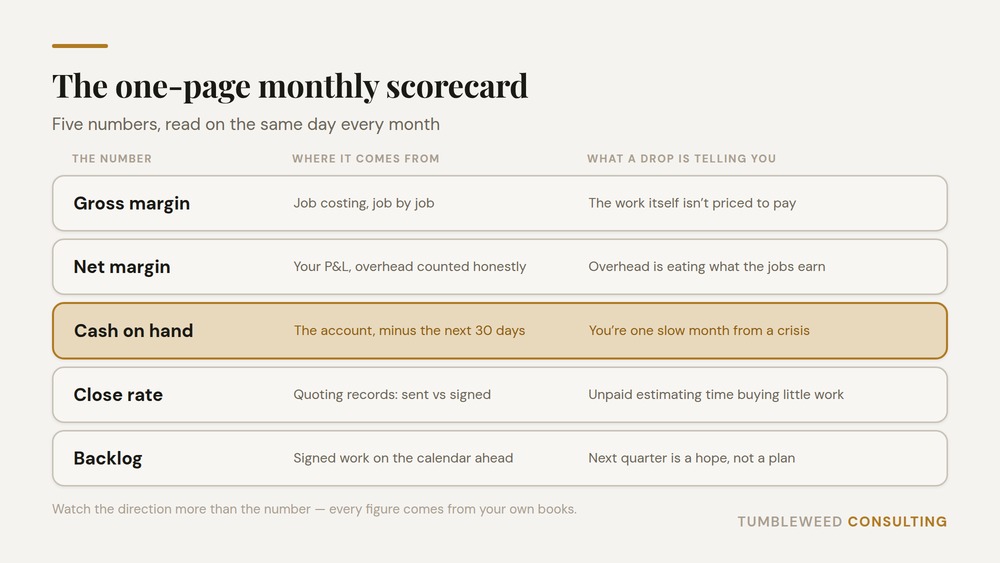
Here are the five I'd want you to be able to answer without digging. You don't need software or an accountant to start caring about them. You need to know them, and then look at them on the same day every month, because that discipline is worth more than any tool you'd keep them in.
1. Gross Margin — Are the Jobs Themselves Making Money?
Gross margin is what's left of a job after you take out the direct cost of doing it — materials and burdened labour — before any of your overhead. It answers the most basic question there is: does the actual work make money, job by job, before the office even gets involved?
If your gross margin is thin, nothing downstream can save you, because there's not enough coming off the jobs to carry the overhead, let alone leave profit. And a lot of thin gross margin traces straight back to pricing that was built on an understated cost. When contractors find out their gross margin is lower than they assumed, it's usually because where your margin quietly disappears is right there in the estimate — labour priced at the wage, materials priced off an old number, scope creep never billed.
2. Net Margin — Is Anything Left After the Whole Business Runs?
Net margin is what's left after everything — the jobs and the overhead, the rent, the insurance, the trucks, the admin, your quoting time. It's the number that tells you whether the business, as a whole machine, made money or just moved a lot of it around.
This is the one that surprises people most, because a business can have decent gross margin on its jobs and still land near zero net once the overhead is counted honestly. If you've never separated the two, your P&L can quietly blur them together — and your P&L can hide whether the year was even profitable depending on how it's structured and how often you actually read it. The gap between gross and net is where the size of your overhead becomes real, and it's often the first thing that explains why a busy year didn't feel like a rich one.
3. Cash on Hand — Could You Survive a Slow Month?
Profit and cash are two different problems, and cash is the one that actually kills businesses. I ran four jobs at once one stretch, technically making money on every one of them, and nearly went under anyway — because the costs came due on schedule and the money came in whenever the clients and their accountants got around to it. Profit on paper isn't dollars in the account.
"Profit and cash are two different problems, and cash is the one that actually kills businesses. Profit on paper isn't dollars in the account."
So the number here is simple and brutal: how many months could you cover payroll and your fixed costs if the work slowed down and the receivables came in late? If the answer is "I'm not sure" or "about two weeks," that's not a healthy business — that's a busy one running without a cushion, one bad month from a crisis. That's how an operator ends up busy and broke at the same time, and watching your cash position instead of only your P&L is what keeps a profitable business from dying of timing.
4. Close Rate — Is the Sales Side Actually Working?
Close rate is the share of the quotes you send that turn into signed work. Most contractors don't track it, which means they're flying blind on the entire front end of the business. If you're quoting everything that moves and closing a small fraction, you're burning a lot of unpaid estimating time to win a little work — and that's a real cost hiding off the books, which is exactly why I tell contractors to stop handing out estimates for free.
A close rate also tells you something a revenue number can't: whether you're winning the right work or just chasing volume. Winning a pile of low-margin jobs isn't the same as a healthy pipeline. Not all of your revenue is worth the same — some of it costs more to deliver than it pays, and a close rate that climbs because you're quoting cheap is a warning, not a win. Knowing your close rate, and pairing it with your average job value, tells you whether the sales engine is producing profit or just motion.
5. Backlog — Is There Secured Work Ahead?
Backlog is the signed, committed work you have lined up in front of you. It's the number that tells you whether next quarter is a plan or a hope. A contractor with a strong backlog can make calm decisions — hire, invest, turn down the wrong job. A contractor with no backlog makes desperate ones, takes the bad client, cuts the price to keep the crew busy, and slides into the race nobody wins.
Watching your backlog is how you see a slowdown coming while there's still time to do something about it, instead of finding out when the current job wraps and the calendar behind it is empty.
Where These Numbers Actually Come From
None of this needs new software, and it definitely doesn't need to wait for your accountant. Your year-end is a history lesson. What you want is something you can read while the year is still fixable.
Gross margin and net margin come out of your own job costing and your P&L, which means they're only as honest as the costs you put against each job — if labour is going in at the wage instead of the burdened rate, your gross margin is fiction before you start, because what an employee actually costs you is never just what lands on their cheque. Cash on hand is the easiest of the five and the one people avoid, because it takes about four minutes: what's in the account, what's committed in the next thirty days, what's actually going to land in the next thirty days. Close rate and backlog come from your own quoting records, assuming you keep them — and if you don't, starting to is the first job.
Pick a day. The first Monday of the month, the last Friday, it genuinely doesn't matter which, only that it's the same one every time so it becomes a habit instead of a decision. Put all five on one page. It should take under an hour once you've done it twice.
And watch the direction more than the number itself. A nine percent net margin doesn't mean much on its own — a nine percent that was fourteen percent two quarters ago means quite a lot, and it means it early enough to do something about. The point of looking monthly isn't precision. It's catching the slope while it's still gentle.
"Busy is a feeling. Healthy is five numbers you can actually answer. The businesses that get in trouble almost always felt fine — right up until the month the feeling and the numbers finally disagreed out loud."
The Bottom Line
You don't manage a construction business by how it feels or what the bank balance did this week. You manage it by a small handful of numbers — gross margin, net margin, cash on hand, close rate, and backlog — looked at on the same day every month, so you see the story changing while you can still change it. The spreadsheet isn't the fix. The discipline of actually looking is the fix.
If you've read this far and realized you couldn't confidently put a number next to more than a couple of these, you're not behind — you're just where most contractors are, because nobody ever taught this part. Getting an honest read on all five at once is exactly what the Full Contractor Health Check is built to do, and working the numbers month over month is the core of my construction business coaching — one clear picture of where your business actually stands, and what to do about it in the next ninety days.
Quick answers
How do I know if my construction business is healthy?
Look at five numbers, not your bank balance: gross margin (are the jobs themselves profitable), net margin (is anything left after overhead), cash on hand (could you survive a slow month), close rate (is the sales side working), and backlog (is there secured work ahead). A business can be busy and still fail every one of these — busy is a feeling, healthy is measurable.
What numbers should a contractor track every month?
The short list is gross margin, net margin, cash on hand, close rate and backlog, with average job value worth pairing against your close rate. You don't need a complicated system — you need the same handful of numbers looked at on the same day every month. The discipline of reviewing them matters more than the tool you keep them in.
What's a healthy net margin for a construction business?
It varies by trade and size, but many small contractors are running far thinner than they assume once overhead is counted honestly — and some are at or below break-even without realizing it. The exact target matters less than knowing your real number and watching whether it's moving the right direction over time.
Get The Builder's Playbook in your inbox
A short note from Eddy with a link to the week's post — one email a week, every Thursday, nothing else.
No spam. Unsubscribe with one click any time. Privacy policy.
This site is protected by reCAPTCHA and the Google Privacy Policy and Terms of Service apply.