
I sat down one January and added up every estimate we'd produced in the previous twelve months that hadn't converted to a contract. I was expecting the number to sting. I was not expecting it to be three hundred and forty hours of my estimator's time, plus probably sixty of mine, spent producing detailed proposals for people who never built anything with us. In many cases, who were never genuinely going to.
That wasn't a sales problem. That was a free consulting business I'd accidentally been running inside my construction company.
The Conversion Rate That Tells the Real Story
Most contractors who come to me frustrated about their sales process are actually frustrated about the wrong thing. They think they need more leads. What they usually need is fewer leads of higher quality. There is a profound difference between those two problems, and solving the wrong one is expensive.
If your estimate conversion rate is sitting below 25%, the revenue problem you feel isn't being caused by a shortage of opportunities. It's being caused by an absence of qualification. You are doing serious, skilled, unpaid work for a large proportion of people who either don't have the budget for what they want, aren't actually ready to build, or are collecting bids the way some people collect quotes on cars they have no intention of buying.
"They think they need more leads. What they usually need is fewer leads of higher quality."
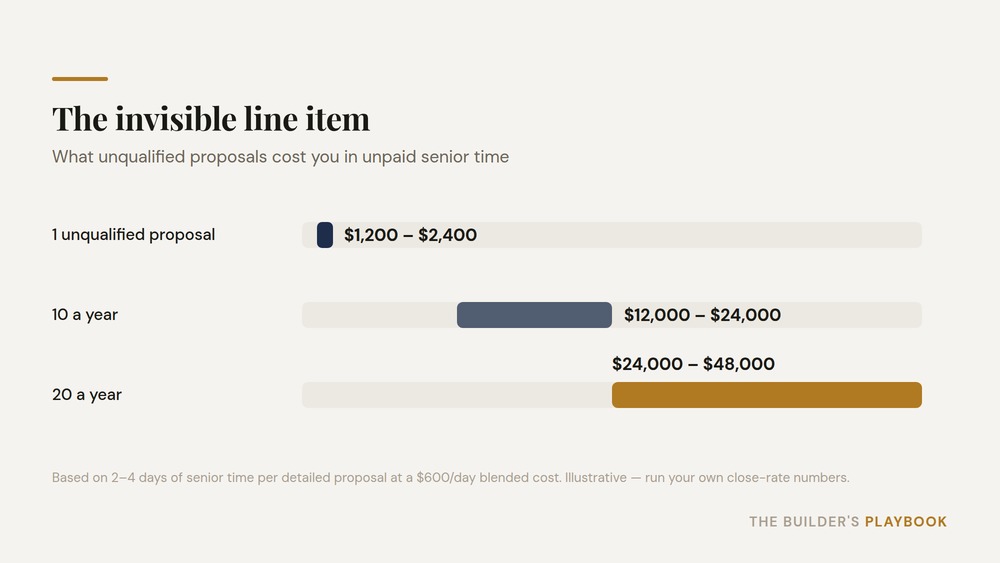
The rough cost of a detailed residential proposal (site visits, scope development, specification research, and the write-up itself) runs two to four days of senior time depending on project complexity. At a conservative blended cost of $600 a day for the people involved, an unqualified proposal costs you $1,200 to $2,400 that you will never see back. Multiply that by the number of estimates you produce in a year and compare it to the number that actually close. For most contractors I work with, the number lands somewhere between uncomfortable and genuinely alarming. And the reason it stays hidden is that your P&L makes the business look healthier than it is: the cost of unqualified proposals never shows up as a line item. It just silently shows up as margin that should exist but doesn't. That cost is part of why I eventually built QuantApp, my own estimating software — faster estimates shrink the number, but they don't fix it. Qualification does.
Qualifying the Project Before You Qualify the Person
The first mistake most contractors make in their sales process is trying to qualify the client before they've qualified the project. It's backwards. A technically pleasant client with the wrong project is still the wrong fit, and discovering that after you've produced a full proposal is just expensive discovery.
The four things I look at before I agree to invest in an estimate: project type and scope, site viability, stage of readiness, and budget alignment. Project type and scope means asking honestly whether this is the kind of work your company does well and would be proud to have in your portfolio. Not whether you technically could do it. Whether it plays to your actual strengths. A scope that takes you outside your lane produces higher cost, lower quality, and often a client relationship that ends badly even when you do your best work.
Site viability means asking the early questions about access, location relative to your operations, and any physical constraints that would complicate the build before you've walked away from two hours of estimating time. Stage of readiness means determining whether they actually control the site, have a design in progress, and have taken any concrete steps toward building. A prospect who's still six months from permit-ready is not a proposal-ready lead. And budget alignment means having the honest conversation early, before either party has invested heavily in the relationship, about whether what they want can be built for what they're expecting to spend.
That last conversation is the one most contractors avoid because it feels like a confrontation. It isn't. Done with directness and care, it's the most respectful thing you can do. Letting someone believe you're building them a project you both quietly know doesn't fit their budget is not a kindness. It's a waste of their time and yours. It's also a different conversation from the one that comes at the very end, when a client who has already decided asks for a little movement on the number — that ask is usually about the deal, not the budget, and it gets a different answer.
The Budget Conversation Nobody Wants to Have
There's a reason the budget question gets avoided. Clients often deflect it, or give numbers that don't reflect their actual expectations, or simply haven't done the research to know what their project realistically costs. So contractors learn to skip the question rather than have an awkward conversation that might end a promising relationship before it starts.
The problem is that skipping it doesn't avoid the awkward conversation. It delays it to a worse moment: after you've invested forty hours, after they've gotten excited about your proposal, after you've built a working relationship. Walking away at that stage costs everyone more.
The better approach is to ask the budget question as part of a genuine conversation about their priorities, not as an interrogation. Something like: "Have you established a range for this project, and how did you arrive at that number?" That second part, how did you arrive at it, tells you more than the number does. It tells you whether they've done any research, what their reference points are, and how closely their expectations align with what the scope actually costs to build. If the gap between their expectation and project reality in your market is too large to close with an honest conversation, the right answer is to say so clearly, explain why, and step back. That honesty, delivered without condescension, builds more trust and generates more referrals than the proposal you never should have written would have.
"The cost of unqualified proposals never shows up as a line item. It shows up as margin that should exist but doesn't."
Why Saying No Is Actually a Sales Strategy
There's a counterintuitive truth in construction that takes most contractors years to act on: the companies with the best reputations are often the most selective about which jobs they take. Not the most expensive. Selective. They say no to projects that don't fit, clients who show early signs of being difficult, and scopes that would compromise the quality of work they're known for. And rather than costing them business, that selectivity is part of what actually sets them apart from every other contractor bidding the same job.
When you say no to a project that isn't right for your company, you do it respectfully: thank them for their time, explain briefly that the fit isn't right for your firm, and if possible suggest a better direction for them. Done well, that conversation doesn't end a relationship. It often starts one. The prospect remembers the contractor who was straight with them and didn't waste their time. The referral often comes from that person, even though they didn't build with you.
More practically: every hour you spend chasing proposals that won't close is an hour you're not spending on clients who will. Your best people have a finite amount of careful attention to give. If they're spending it on unqualified opportunities, the clients you actually want are getting less of it: slower turnaround, thinner proposals, less of the thoughtful pre-sales work that makes the difference between closing a sale without the pressure tactics and not closing at all. The job that cost me twenty-two thousand dollars started with exactly this problem: I said yes to a project I should have qualified out, and I paid for that decision with eight months of difficulty and a number that still irritates me when I think about it.
What a Working Qualification Process Actually Looks Like
Building a qualification process doesn't require a CRM overhaul or a new hiring strategy. It requires clarity on four things: who is this project right for, what questions do we ask in the first conversation, what are the specific red flags that mean we walk away, and who is responsible for making that call.
The red flags worth tracking explicitly: refusal to discuss budget after reasonable trust has been established, requests for detailed proposals before a site visit has happened, a disclosed history of conflict with previous contractors, or obvious disrespect toward your team during the early conversations. None of these are automatically disqualifying on their own, but all of them are worth weighing seriously against the value of the opportunity.
The result of building a real qualification process (one you actually follow, not just intend to follow) is fewer estimates, a meaningfully higher conversion rate, and a team focused on opportunities that close rather than grinding through proposals that won't. What happens when you try to manage a sales gap without a qualification process is instructive: the gap doesn't shrink, it just gets more chaotic, because you're still chasing volume rather than quality.
I've watched contractors cut their estimate volume in half and double their revenue within eighteen months. Not because they got better at writing proposals. Because they stopped writing them for people who were never going to build.
The Bottom Line
Every estimate you produce without qualifying the client first is a withdrawal from a bank account labelled "senior time," and that account is not unlimited. The cost of unqualified proposals is real and calculable, and in most construction businesses I've worked with, it runs to six figures annually in absorbed labour cost that nobody ever adds up. That's not a marketing problem or a pricing problem. It's an operations problem with a straightforward fix.
Build a qualification framework, write down the four questions you'll ask before you agree to estimate, identify your specific red flags, and give someone clear authority to say no. If you're not sure what that looks like for your particular business, that's exactly the kind of clarity my construction business coaching helps construction and trades business owners develop. The goal is a business where your best people are spending their time on opportunities that actually close, and where walking away from the wrong ones is a deliberate act, not a last resort.
Quick answers
Why is a low estimate conversion rate a problem for contractors?
A low conversion rate means you are spending significant unpaid labour — your estimator's time, your project manager's time, sometimes your own — producing proposals for clients who were never seriously going to hire you. Over a year, that free labour adds up to a real dollar cost that most contractors never actually calculate. It also crowds out time that could go toward closing clients who are genuinely ready.
How should a contractor qualify a lead before investing in an estimate?
A basic qualification covers four things: whether the project type is within your area of expertise, whether the location and site are feasible for your operations, whether the client has a realistic budget for the scope they're describing, and whether there's a genuine timeline driver behind their interest. Projects that fail any of those criteria deserve a respectful conversation, not a detailed proposal.
What is a realistic estimate conversion rate for a residential contractor?
A healthy conversion rate for a residential contractor with a working qualification process is typically in the 30–50% range. If you are closing fewer than one in four estimates, the issue is almost always qualification upstream, not your proposal quality or your pricing.
Get The Builder's Playbook in your inbox
A short note from Eddy with a link to the week's post — one email a week, every Thursday, nothing else.
No spam. Unsubscribe with one click any time. Privacy policy.
This site is protected by reCAPTCHA and the Google Privacy Policy and Terms of Service apply.