
I've run jobs where the costs showed up right on schedule and the money showed up whenever the client's accountant got around to it. Every job making money on paper, and the bank account going the other way. I wrote about it in busy and broke at the same time, and for most of the years I've been in construction in BC that was simply how it worked. You invoiced, you waited, and the waiting rolled downhill to your subs and suppliers.
That's about to change. BC's Construction Prompt Payment Act received royal assent on November 27, 2025. When I wrote this in October 2026 it wasn't in force yet; it comes into force on a date set by regulation, the province consulted on those regulations until July 7, and the government has said it proposes applying the Act to all projects. So the date is still open. What the law will ask of your company isn't.
What the clock looks like
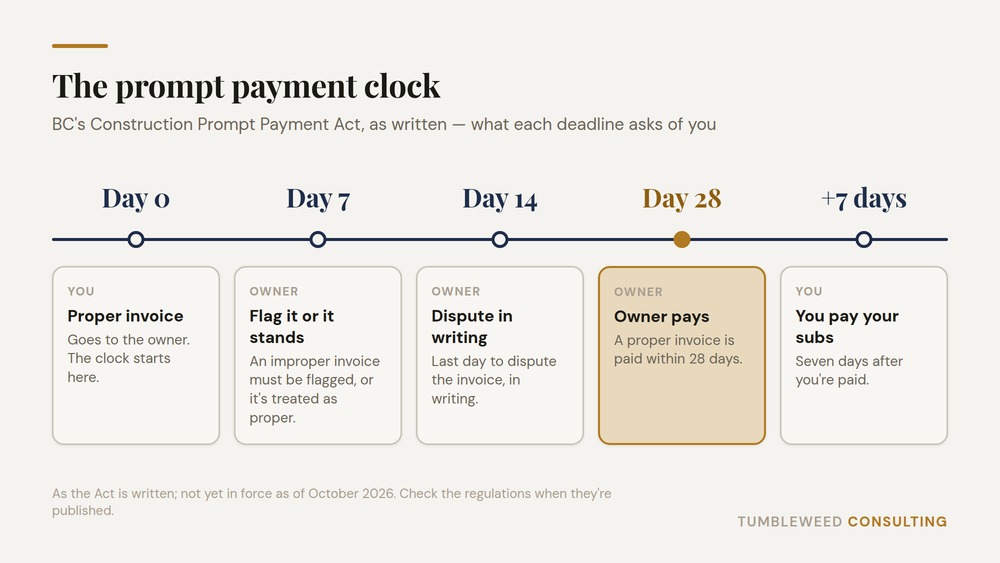
As the Act is written, an owner has 28 days to pay a proper invoice. An owner who disputes an invoice has 14 days to say so in writing, and if an invoice doesn't meet the requirements, the owner has 7 days to tell you or it's treated as proper. Once you're paid, you have 7 days to pay your subcontractors. Disputes go to adjudication, where an adjudicator gives a written decision within 30 days. The regulations will fill in details, including exactly what a proper invoice has to carry, so check them when they're published.
On paper this is good news for contractors, and it is. But read those numbers from the other side of your own desk. The same law that makes your client pay you in 28 days makes you pay your subs in 7. It turns every invoice, every approval and every dispute into something with a deadline, and a deadline is only useful to a company whose paperwork can keep up with it.
"The law sets the clock. Your company still has to keep the time."
Where most companies will feel it first
The first place is the invoice itself. In a lot of construction companies, invoices go out when the office gets to them, in whatever format the last person used, sometimes missing the purchase order or the contract reference, sometimes waiting on a PM to confirm the percentage complete. Under prompt payment the clock starts on a proper invoice, so an invoice that's late, vague or missing a reference just costs you days you'll never get back. Billing has to become a process with an owner and a schedule, not a job that happens when someone has a quiet afternoon. If it currently lives with one person, if it lives in someone's head, it's not a system, and this is the year that matters.
The second place is your subs. Seven days is not much time if paying a subcontractor means one person approving every invoice and that person is out on site three days a week. Somebody has to own sub invoices, check them against the work and the contract, and have the authority to release payment without waiting for the owner. Prompt payment rewards the subs who invoice properly too, so it's worth telling the ones you rely on what you'll need from them. That's part of managing subcontractors now, not a favour.
The third place is disputes. Under the old way, a problem with a sub's work or a client's invoice could sit for weeks while people argued about it on site. Now a dispute has a 14-day window and has to be in writing. That means PMs writing down deficiencies the day they find them, with photos, and getting that note to whoever handles billing. It's the same habit as a signed change order before the work starts: slow down enough to do the paperwork, because the paperwork is what holds up later.
Faster in, faster out
Being paid in 28 days is better for cash than being paid whenever. But paying out in 7 changes the timing of everything else, and a company that has never planned cash week by week will find the new rhythm just as easy to get wrong as the old one. Know what's due in and what's due out for the next few weeks, job by job, and know which invoices haven't gone out yet. Adjudication is fast, and fast favours the side with organized records: the signed contract, the dated invoices, the written notices. If your contracts and correspondence are scattered across three inboxes and a truck, that's the first thing to fix.
"Prompt payment won't make anyone pay you. It makes the organized companies get paid first."
Do it before the date is set
The useful thing about the delay is that it gives you time. Walk one invoice from the job site to the bank and write down every step, who does it and how long it takes. Do the same for a sub invoice going the other way. Wherever a step depends on one person remembering, give it an owner and a deadline. None of that needs the regulations to be final, and all of it makes the company run better whether the law lands next spring or the spring after.
Then sit down with your management team and decide who owns each piece. In a lot of companies I've seen, billing belongs to the office, approvals belong to the PMs and cash belongs to the owner, and nobody owns the hand-offs in between. That's where the days go. An invoice sits waiting for a PM to confirm a percentage complete, the PM is waiting until he's back on that site, and the office doesn't chase him because chasing PMs isn't anybody's job. Under the old way that cost you a few weeks of cash and some grumbling. Under a 28-day clock with 7 days to pay your subs, it costs you the whole benefit of the law. Put a name and a deadline on every hand-off, write it on one page everybody can see, and keep it on the agenda at your monthly management meeting until it runs without anyone having to think about it.
The Bottom Line
The law won't chase your invoices for you. What it does is reward the companies that already bill properly, approve on time and write things down, and it puts the companies that don't on a clock they can't keep. The law is the easy part. The billing process is the part you'll have to build.
If your billing still depends on one person remembering, that's the kind of process I go through with management teams before it costs them. See how management consulting works.
Quick answers
Is BC's Construction Prompt Payment Act in force?
Not yet, as of October 2026. It received royal assent on November 27, 2025, and comes into force on a date set by regulation. The province consulted on the regulations until July 7, 2026, and has said it proposes applying the Act to all projects.
How long does an owner have to pay under BC's prompt payment law?
As the Act is written, an owner pays a proper invoice within 28 days, and an owner who disputes it has 14 days to say so in writing. A contractor then has 7 days to pay its subcontractors. Check the regulations for the final details when they're published.
What should a construction company change before prompt payment takes effect?
Make invoicing a process with an owner and a schedule, put a deadline on approving sub invoices, get PMs writing down deficiencies the day they find them, and plan cash week by week. The clock only helps a company whose paperwork can keep up with it.
Get The Builder's Playbook in your inbox
A short note from Eddy with a link to the week's post — one email a week, every Thursday, nothing else.
No spam. Unsubscribe with one click any time. Privacy policy.
This site is protected by reCAPTCHA and the Google Privacy Policy and Terms of Service apply.