
I had a tile setter no-show on a Monday morning two weeks before a project was supposed to be complete. No call, no text — just didn't appear. The client was walking through the site that Friday. I'd already told them we were on track.
I spent the next four hours calling everyone I knew, ended up pulling in someone I hadn't worked with before at a premium rate, and got through it — but the whole situation was my fault. Not because the tile setter flaked, which he definitely did. My fault because I'd called him on a Thursday, gotten a verbal yes, and put him in the schedule based on nothing more than that. No written scope, no confirmation, no backup plan.
That job cost me a relationship with the client I'd spent two years building, because the schedule slip messed up their moving timeline and they were furious. The client didn't distinguish between my work and my sub's work. As far as they were concerned, it was all my project — and they were right.
Your Subs Are Your Brand on Site
This is the fundamental reality of subcontractor management that a lot of contractors don't fully internalize until they've lived through the expensive version of the lesson. The client hired you. They signed a contract with you. When they walk the site, they're evaluating your work — all of it, including every phase that was performed by someone else under your coordination.
When the electrician's rough-in isn't labelled the way you promised it would be, that's on you. When the drywall finisher leaves compound dust across the floors the hardwood installer just finished and the hardwood installer has to stop and clean up, that delay shows up in your schedule and your budget. When the painter cuts corners on prep because nobody defined what "acceptable prep" meant before he started, the callback is yours.
This isn't about blaming yourself for things you didn't do. It's about recognizing that the outcome belongs to you regardless of who caused the problem — and once you accept that fully, you stop managing sub relationships reactively and start managing them the way they actually need to be managed.
The job that almost broke me had a sub problem at its centre. Not one dramatic failure, but a series of small ones that compounded because I'd made verbal agreements, assumed things, and didn't have a clear accountability structure in place for the people I was depending on.
The System Most Owners Don't Have
The version of sub management that actually works is built before the first invoice, not after the first problem. In BC it's about to matter on the money side too, because prompt payment gives you seven days to pay your subs once you've been paid.
It starts with a written scope of work for every sub on every project. Not a verbal agreement on site, not a text message confirmation, not a relationship you've had for six years. A written scope that defines what they're doing, what "complete and acceptable" looks like for their phase, what they're responsible for cleaning up after themselves, and what the timeline is. This doesn't have to be a 10-page legal document. It can be a single page. But it has to exist, it has to be signed, and it has to be specific enough that both parties know what done looks like before the work starts.
Verbal agreements feel efficient until they fall apart, and they fall apart in the moments that cost the most. It's the same principle that makes the pre-construction conversation worth having before the first hammer swings — except here you're the one awarding the work rather than receiving it.
The second piece is a defined communication protocol. Who does the sub report to on site? If there's a problem — a conflict with another trade, a change in scope conditions, a question about an existing detail — who do they contact, and how? What's the expected response time? What happens if they're running behind and it threatens the schedule? Subs who work for organized contractors appreciate this clarity. The ones who push back on it are showing you something important about how they operate.
"The clients who pay you to manage a project are paying for the outcome, not the attempt. When a sub fails, they don't see a sub failure. They see your failure."
Vetting Before You Put Them in Front of Your Client
Most contractors have a go-to list of subs they trust, and for most of those relationships, they're fine. The problem shows up when you need someone new — when your usual electrician is booked, when you're in a new territory, when a specialty trade comes up that you don't have a tested relationship for.
The instinct under schedule pressure is to ask around quickly, get a name, get a verbal yes, and move on. That instinct is understandable and almost always wrong. A sub you've never worked with before has no track record with you. Their references might be from people who had one decent experience with them. Their insurance might not be current. Their work might be technically acceptable and still not match the standard your client expects.
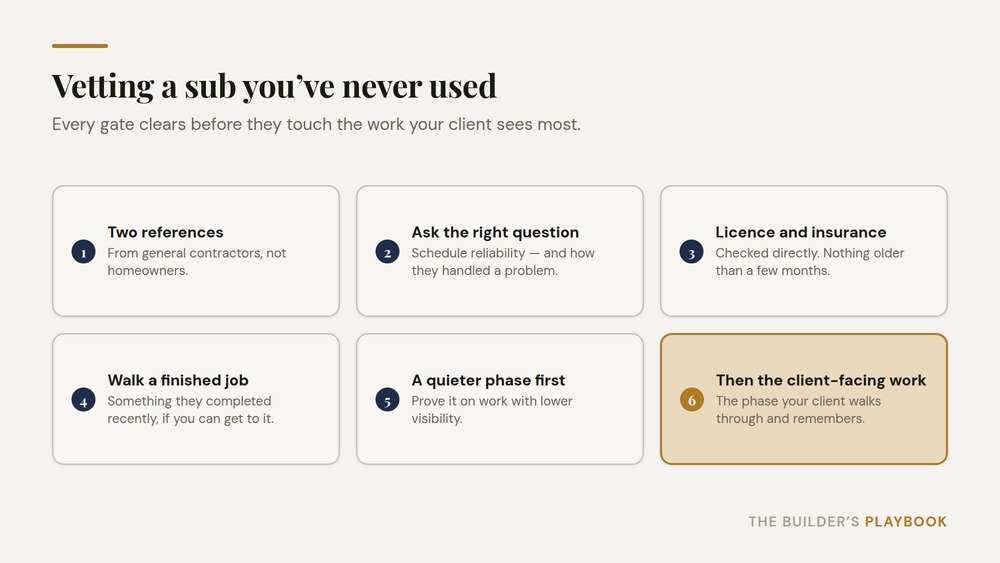
My process for a new sub: ask for two references from general contractors, not homeowners. Call those references and ask specifically about schedule reliability and how they handled a problem when something went wrong. If possible, ask to see a job they've completed recently. Check their licence and insurance directly — don't accept a certificate that's more than a few months old. And if you can structure it, use them on a lower-visibility phase before you put them on the work your client sees most.
That process takes time. It's worth it every single time, because the alternative is discovering a reliability problem in the middle of a project when the cost of that discovery is highest. Quality is a system, not a value you declare — and your sub vetting process is part of the quality system, even though it happens before a single tool is picked up on site.
Keeping a Real Track Record
Most contractors have a rough mental sense of which subs they'd call again and which ones they wouldn't. The problem is that memory compresses and distorts — you remember the most recent experience and the most dramatic one, but the medium-level stuff that accumulated over three years gets fuzzy. You end up giving someone one more chance without fully accounting for how many last chances they've already had.
"Memory compresses and distorts. You end up giving someone one more chance without fully accounting for how many last chances they've already had."
A written track record doesn't need to be complicated. After every project, a simple note: sub name, phase, did they show up on schedule, was the quality acceptable, how did they handle a problem if there was one, would you use them again and on what type of work. That's it. Four or five data points per sub per project. After a year, you have something you can actually use — not just a feeling, but evidence.
When information lives in one person's head instead of in a system, it doesn't scale and it doesn't transfer. If you have a foreman or project manager who coordinates subs, the track record needs to live somewhere they can access and add to it — not just in your head, and not just in theirs.
What Good Subs Are Looking For
Here's the part of the sub reliability conversation that often gets skipped: good subs actively want to work for organized contractors. They want clear scopes, predictable schedules, and a general contractor who communicates well and pays on time. That's a rare enough combination that when they find it, they prioritize it.
When you raise your standards for subs — written scopes, clear communication requirements, a defined quality bar — the subs who don't want to meet those standards self-select out. Sometimes that feels uncomfortable, especially if you've had a long relationship with someone. But the ones who push back on basic process are the same ones who'll cost you when the schedule is tight or the client is watching closely. Let them find a contractor with lower standards. They'll find one.
The subs you want to build long-term relationships with are the ones who respond to a clear scope with "yes, I understand, let's do it." Over time, as they experience working with an organized contractor who pays on time and communicates well, those relationships become genuinely reliable. Scaling quickly without systems accelerates every sub management problem you have — more projects, more new subs, less time for each relationship, more variables that can fail. The systems have to be in place before you need them at scale.
The Bottom Line
Subcontractor reliability problems are almost always systems problems wearing the costume of people problems. The no-show sub, the mediocre tile work, the phase that runs three days over — these things happen partly because people are unreliable, yes, but mainly because the expectations, documentation, and accountability structures weren't in place before the work started. It's also why buying an app rarely helps on its own — project management software won't fix a people problem you haven't defined yet.
You can't control how other people behave. You can control the clarity of what you communicate to them and the process you use to select and manage them. When you build those systems and hold them consistently, the quality of your sub relationships improves over time — and the ones who can't meet your standards become easier to replace because you're not dependent on them.
If you want to think through your sub management process and find where the gaps are, that's exactly the kind of practical work my construction business coaching is built around.
Quick answers
How do you deal with a subcontractor who doesn't show up on schedule?
The best time to address schedule expectations is before the project starts, not after the first no-show. A written scope that defines schedule requirements, communication protocols, and consequences for delays gives you something to point to and signals to subs that you're an organized contractor who enforces standards.
How do you vet a new subcontractor before using them on a project?
Ask for references from general contractors they've worked for recently, check their licence and insurance, and — if possible — walk a job they've recently completed before putting them in front of your client. A new sub should prove themselves on lower-visibility phases before you put them on the work your client sees most.
Why is a written scope of work important for subcontractors?
A verbal agreement leaves room for both parties to remember different things. A written scope defines exactly what the sub is responsible for delivering, what the quality standard looks like, what cleanup is expected, and what the communication protocol is — so when a problem arises, you have a reference point, not just competing recollections.
Get The Builder's Playbook in your inbox
A short note from Eddy with a link to the week's post — one email a week, every Thursday, nothing else.
No spam. Unsubscribe with one click any time. Privacy policy.
This site is protected by reCAPTCHA and the Google Privacy Policy and Terms of Service apply.