
I learned the hard way, on a project that was going fine by every technical measure, that a client who thinks they're getting one thing and a contractor who's delivering a different (but still excellent) thing are not going to end up happy together. The work was clean. The timeline was close. The problem was that nobody had sat down before the framing started and made sure we were talking about the same job.
By the time we found out we weren't, we were five weeks in, the client had already told three neighbours about the disaster they were living through, and I was eating cost on changes that I could have documented and billed if I'd just set up the conversation properly at the start.
That's the kind of expensive lesson that changes how you do business.
The Gap Between Sold and Understood
There's a specific gap that lives between the sales conversation and the project start, and most contractors either don't know it exists or they're hoping it doesn't matter this time. The sales conversation is optimistic by nature. You're putting your best case forward. The client is excited. You're both talking about the finished product, not the process of getting there.
The pre-construction conversation is where you close that gap on purpose. It's not the sales conversation. It happens after the contract is signed. Its job isn't to get the work. It's to make sure the client knows exactly what they've bought, what they haven't bought, how you're going to manage the parts that shift, and what they need to do to keep the project on track. That conversation takes about an hour. The disputes it prevents can take months.
"The pre-construction conversation takes about an hour. The disputes it prevents can take months."
What goes wrong in its absence is predictable. The client assumed the allowance figure in the estimate was a commitment. You assumed they understood it was a placeholder. The first time the actual tile selection runs over the allowance, they're blindsided and you're defending a number you never meant as a guarantee. The change order conversation that should have taken five minutes turns into a two-hour negotiation about whether you told them this might happen. You didn't. Not clearly, not in any way they absorbed.
Most of the projects that feel hard partway through have a pre-construction gap at the root. Not a skills gap. Not a scope problem. A communication gap that was baked in before the first person showed up on site.
What the Conversation Has to Cover
The pre-construction meeting covers six things, and I'm not flexible about any of them.
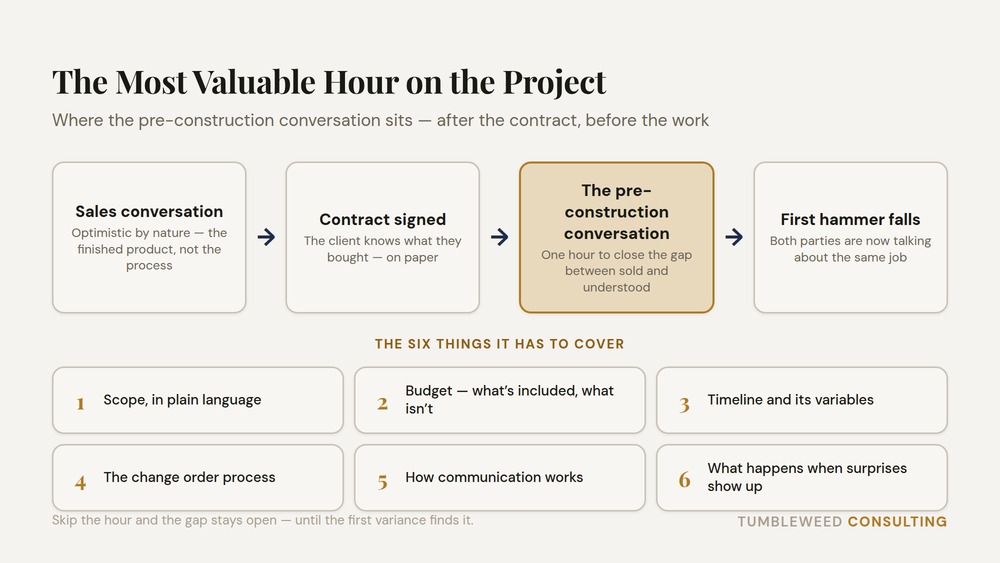
The first is scope, stated in plain language. Not the specification document, not the estimate line items. What is actually happening to their home or building? Where does your work start and stop? What are you not touching? Clients sign contracts they haven't fully read and then are surprised by things the contract clearly covered. Walk them through it in plain language anyway.
The second is budget honesty. What does the number include, and more importantly, what doesn't it include? What are the allowances and what happens if a selection comes in over? What are the site conditions that could add cost if we find them, and how do we handle that conversation when it comes up? A client who has heard all of this before the project starts is a fundamentally different client than one who hears it for the first time when you're asking for more money.
Third is timeline. Not just the projected completion date: the variables that affect it. Permit timing, if it's not in hand yet. Special order materials and their realistic lead times. Decisions the client still needs to make and when those decisions need to happen to keep the schedule intact. A client who books their kitchen renovation for six weeks and then disappears for three weeks to think about countertop colours has derailed their own project. They need to understand that before it happens.
Fourth is the change order process. What it looks like, what triggers it, how it gets approved, and the fact that verbal conversations aren't approvals. This is the one that bites people most consistently. I've seen how a single verbal change order that a client later disputes can turn a profitable job sideways. The job that almost broke me had this exact problem at its centre. The discipline that fixes it is simple enough to state and hard to hold to: price every change, get written approval, then build.
Fifth is communication. Who calls who when something changes on site? How often will they hear from you and through what channel? Who is their point of contact if you're not reachable? Setting this expectation explicitly means the client doesn't spiral into anxiety every time they drive by and notice something looks different than they expected.
Sixth is what happens when something unexpected is found. Because it will be. If you're opening walls in a house built in the 1980s, you will find something. The client needs to have agreed, in advance, to the process for handling that, not be surprised by the conversation when you're already standing in their kitchen with a structural issue in your hand.
The Client Who Was Prepared for Surprises
There's a particular kind of project relationship that shows up when you've done this conversation well, and once you've experienced it you'll never stop doing the meeting. It's the client who, when you call them on a Thursday morning to say you've opened a wall and found something, says "okay, what are our options?" instead of "what do you mean, what does that cost?"
That client was always available. They're not a unicorn. They're what you get when you've done the work upfront to make sure they understood what kind of project this was going to be. They're the client who becomes a referral source and a long-term relationship instead of a case study in how sideways things can go.
"A client who has agreed in advance to the process for handling surprises responds to surprises as a partner. A client who wasn't prepared responds as an adversary. The only difference is one conversation you had — or didn't."
The hardest part of the pre-construction conversation isn't having it. It's being honest in it when you're afraid the honesty will spook the client. Telling someone that their timeline has variables that could affect the end date. Telling them the allowance for tile is tight given what you've seen them drawn to. Telling them there's a specific site condition you'll want to look at more carefully when the demo reveals what's behind the wall. These feel like risks to the relationship. They are, actually, the relationship.
How a complaint turned into a five-year client relationship is almost always a story about honesty that felt risky at the time and built something durable afterward. The same pattern runs through the pre-construction conversation. Say the true thing when it's uncomfortable to say it. The clients who can't handle the truth weren't going to be good clients anyway.
What This Has to Do With Your Brand
Here's the thing about doing the pre-construction meeting well, consistently: it becomes part of what actually makes you different from every other contractor bidding the same work. Most of your competitors are not having this conversation. They're selling the optimistic version, starting the project, and managing the fallout when reality diverges from the pitch. When you're the contractor who sits down, walks through the real picture, explains the process clearly, and helps a client understand exactly what they're getting into — that is a differentiator. Clients talk about it. They refer it.
I've had clients tell me, during the pre-construction meeting itself, that no contractor had ever done this for them before. That comment tells you everything about the bar you're competing against. The bar is low. You can clear it in an hour.
The clients who've been through one of these meetings also approach change orders and variations differently. They've already agreed to the principle that surprises exist and that the process for handling them is what you described. They're not starting from a position of betrayal. They're starting from a position of "we talked about this, what are the options?" That difference shows up in your margin, your stress level, and your ability to manage the gap between sold work and billable work without eating into your own pocket.
The Bottom Line
The pre-construction conversation is the most valuable hour in any project. Not the sales call. Not the closeout walk. The meeting that happens after the contract is signed, before the first person shows up to work, where you and your client sit down and make sure you're both talking about the same job. That hour prevents the disputes that cost you money, the misunderstandings that cost you relationships, and the callbacks that cost you reputation.
If you're not doing this meeting systematically on every project, you're gambling that your assumptions and your client's assumptions line up closely enough to survive contact with a real renovation. Sometimes they do. When they don't, you pay for it in ways that go well beyond the money. Building client management systems that make the pre-construction meeting a non-negotiable part of every project is one of the things I help trades and construction business owners do through my construction business coaching, because the difference between a hard project and a good one often comes down to what was said, or not said, before the ground was broken.
Quick answers
What should be covered in a pre-construction meeting with a client?
The pre-construction conversation should cover the full scope in plain language, what the budget includes and excludes, how change orders are handled, realistic timeline variables like permit timing and material lead times, and how communication will work through the project. The goal is to make sure both parties have the same picture of what's about to happen — before anything is committed.
Why do most construction disputes happen with clients?
Most construction disputes aren't caused by dishonesty — they're caused by mismatched assumptions. The contractor assumes the client understood that renovation timelines shift when unforeseen conditions are found. The client assumed the budget number was a ceiling, not an estimate. Those gaps, left unaddressed before the project starts, turn into conflict the moment the first variance shows up.
How do you set client expectations before a construction project?
The most effective approach is a dedicated pre-construction conversation after the contract is signed but before work starts. Walk through scope, budget, timeline variables, and the change order process together. Write down the key points. When a client has actively agreed to a process for handling surprises, they respond to surprises as a partner rather than an adversary.
Get The Builder's Playbook in your inbox
A short note from Eddy with a link to the week's post — one email a week, every Thursday, nothing else.
No spam. Unsubscribe with one click any time. Privacy policy.
This site is protected by reCAPTCHA and the Google Privacy Policy and Terms of Service apply.