
I finished a $340,000 renovation once and walked away with eleven thousand dollars of net on it. The estimate had shown a 14% margin.
By the time I added up the extra supply runs, the two subcontractors who billed more than we'd agreed, the change orders I'd absorbed to keep the client feeling looked after, and the rework on a tiled bathroom that the tile setter had rushed, there was almost nothing left.
A 14% margin doesn't leave much room to absorb any of that. Whether the markup was ever big enough to carry the overhead is its own question, and worth settling before you go hunting for leaks. But this job didn't die on the estimate. It died in the execution.
What hurt the most wasn't the dollar figure. It was that none of it felt dramatic while it was happening. Every individual decision seemed reasonable in the moment. It was only when I sat down and tried to reconcile the job cost against the original estimate that I could see what had happened. The margin didn't get hit by one thing. It bled out across twenty things, none of which, on its own, would have even registered as a real problem.
Why Construction Budgets Die Quietly
The jobs that blow up dramatically and obviously are not the ones that should worry you most. A catastrophic structural surprise, a material shortage, a sub who disappears: those are painful, but you notice them. You react. You deal with them.
The jobs that hurt you worst are the ones that bleed quietly. An extra trip to the supply house that wasn't planned, because someone forgot to order a fitting. A subcontractor who was two hours late and billed a full day because nobody pushed back. A small design change the client asked for on Tuesday that took four hours of labour you didn't capture anywhere. A piece of material that got cut wrong and had to be replaced. A punch list that took a full day longer than it should have because the last 5% of the job dragged.
Each of those things probably feels like a cost of doing business. Some of them are. But when you add them all up across a six-month project, you get the kind of margin gap that turns a job that should have paid you well into a job that nearly paid you nothing. You spent months of your own energy and your crew's labour getting there. I know what staying busy while the money disappeared actually looks like from the inside. It looks like that $340,000 job.
The Change Order Discipline That Changed Everything
Of all the cost-control habits I've built over the years, the one with the single clearest return has been tracking and billing every change order, every time, before the work is done.
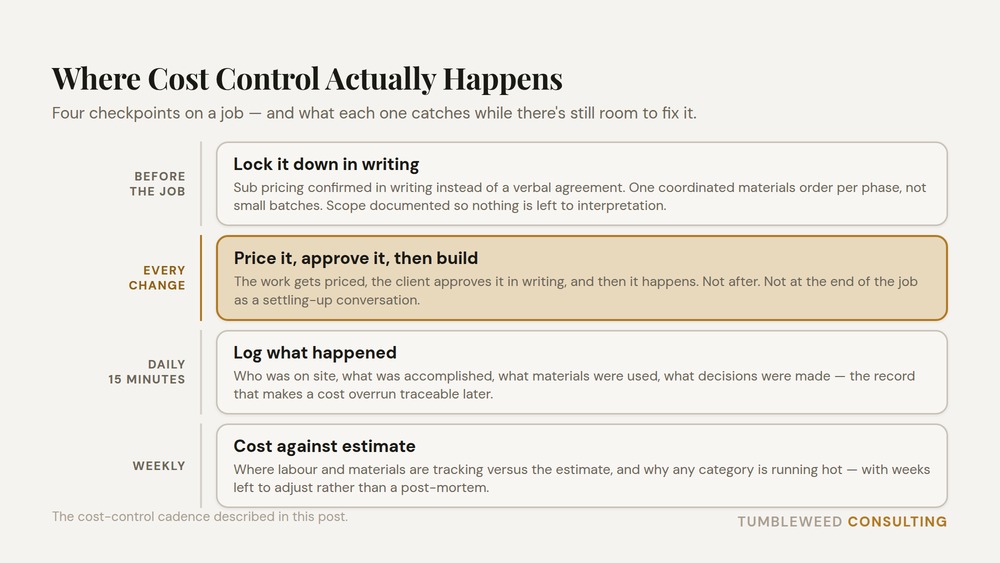
Not after. Not at the end of the job as a "while we're settling up" conversation. Before. The work gets priced, the client approves it in writing, and then we do it. That sequence is non-negotiable in my business now, and it took me longer than it should have to get there.
The version of me who used to absorb change orders had a whole story about why it was a good idea. The relationship is worth protecting. The client will remember this and give us more work. It's not worth the awkward conversation. All of that is understandable, and almost all of it is wrong. The change orders you absorb don't buy the goodwill you think they buy. What they actually do is train the client that your scope boundaries are negotiable and that pushing back on billing will get them somewhere.
"The change orders you absorb don't buy the goodwill you think they buy. What they actually do is train the client that your scope boundaries are negotiable."
Billing every change order professionally and clearly (written approval before you start the work) is not an adversarial move. It's how professional construction businesses operate. Clients who are worth working with will respect the process. Clients who fight every documented change order have a different problem than your paperwork, and that problem was going to surface somewhere.
What a change order habit actually looks like in practice is less about paperwork and more about having a consistent conversation every single time. It becomes routine faster than you'd think. And the margin you protect by doing it consistently will outperform almost any other operational change you can make.
Pre-Job Planning Is Where You Win or Lose
By the time you're on site, most of the variables that will determine whether this job finishes at the estimated margin have already been set. The sub pricing is locked in or it isn't. The materials are ordered in a way that minimizes extra runs and delays, or you're going to be improvising all the way through. The scope is clear and documented, or you're going to spend the next three months negotiating what was and wasn't included.
This is why the work that happens before the job starts is often where the real money gets made or lost. Ordering materials in bulk at the beginning of a phase rather than in small batches as you need them. Confirming subcontractor pricing in writing before the start date rather than operating on a verbal agreement that both parties remember differently when they're both under pressure. Getting every scope item spelled out clearly enough that a change order conversation later won't be a fight about what was obvious.
I've done enough jobs both ways to know the difference. The ones where I'd done the pre-job work carefully: tight sub agreements, a single coordinated materials order, a scope document that left nothing to interpretation. Those jobs tracked to estimate. The ones where I'd cut corners on the front end to get moving faster always paid for it somewhere in the middle, usually at a point where the only options were expensive.
The Weekly Review Nobody Wants to Do
I'm going to tell you something that you probably already know and that you probably don't do consistently: review your job costs every week against the estimate.
Not at the end of the project. Not when you notice something feels off. Every week, for the duration of the job. Where are we on labour versus estimate? Where are materials tracking? Are there any cost categories running hot, and if so, why?
"By the time you review costs at project completion, there's nothing left to do except record what happened."
The reason this matters is simple: by the time you review costs at project completion, there's nothing left to do except record what happened. A weekly review gives you a window to actually respond. Labour tracking 15% over estimate in week four means you can investigate the cause (rework? crew inefficiency? scope that was underestimated?) and adjust before the problem compounds for another eight weeks.
I've seen this habit, done consistently, close the gap between estimated and actual margin by several percentage points over a year. That's not a small number. On a million dollars of revenue, moving from a 6% net to a 9% net because you're catching cost overruns in real time rather than at the end is $30,000 you didn't leave on the table. Your P&L showing healthy revenue while the net is a disaster is often a symptom of exactly this: costs running quietly over estimate, project after project, with no feedback loop to catch them.
Daily Logs Are Cheap Insurance
Fifteen minutes at the end of each day will pay back many times over the course of any project of meaningful size. Who was on site, what was accomplished, what materials were used, what decisions were made.
The obvious payback is in disputes. When a client challenges whether a task was completed, or a subcontractor disputes what was agreed on site, or an insurance issue requires documentation of what happened on a specific date, the daily log is the difference between having clear evidence and having a conversation about who remembers what. The job that almost broke me would have gone differently with better documentation. I know that now.
The less obvious payback is in cost tracking. When you're reviewing job costs weekly and trying to understand why materials are running over, a daily log that shows exactly what was used on which day is how you trace it back. Waste from bad cuts, materials that got used on the wrong phase, a delivery that came up short: these things are findable with a daily log and almost impossible to reconstruct without one.
The Bottom Line
Budget bleed in construction is almost never one thing. It's fifteen things that each seem manageable in isolation and together represent the margin you worked for and didn't get paid. Pre-job discipline, locked-in sub agreements, change order tracking, weekly cost reviews, and daily logs aren't glamorous. They're the operational foundation that separates builders who make money from builders who stay busy while wondering where it went.
The hardest part is that all of these habits require more front-end work than it feels like they're worth, right up until the first job where they save you $40,000 in the last two weeks of a project. After that, you stop questioning them.
If you want help building a cost-control system that fits a trades business at your scale, that's the kind of work my construction business coaching is built around. The ROI on getting it right is usually visible within a project or two.
Quick answers
What causes construction project budgets to go over?
Most budget overruns in construction aren't caused by one big mistake — they come from an accumulation of small, untracked leaks: absorbed change orders, unplanned supply runs, rework, subcontractor billing discrepancies, and material price increases that never made it to a change order. Individually none of these look alarming, but together they can eliminate a margin that looked solid on the estimate.
How often should a contractor review job costs on a project?
Weekly, at a minimum. A review at project completion tells you what went wrong but gives you no ability to correct it. A weekly cost-versus-estimate check gives you the chance to identify where costs are running hot, have conversations with subs or suppliers, and make adjustments while there's still room to protect the margin.
Should contractors charge for change orders on small extras?
Yes, every time — and in writing before the work is done. The small extras you absorb to protect a client relationship almost never generate the goodwill you're hoping for, and they establish a pattern where the client expects the next one to be free too. Billing consistently and professionally for every scope change is not a relationship risk; it's what professional construction companies do.
Get The Builder's Playbook in your inbox
A short note from Eddy with a link to the week's post — one email a week, every Thursday, nothing else.
No spam. Unsubscribe with one click any time. Privacy policy.
This site is protected by reCAPTCHA and the Google Privacy Policy and Terms of Service apply.