
Somebody, somewhere, told a generation of contractors that the number is cost plus ten percent. I don't know who started it, but I've heard it in a hundred versions on a hundred job sites, and it has quietly starved more good trades businesses than almost anything else I can name.
The trouble is that there's no such thing as a contractor markup percentage that works for everybody. A guy will tell me, with real confidence, that he adds ten percent because "that's the industry standard," and I have to break it to him that ten percent markup is barely a nine percent margin, which is the difference between markup and margin biting him before he's even started, and that for most contracting businesses nine percent doesn't even cover the overhead — never mind pay him anything for owning the place and carrying the risk.
So when a contractor asks me what the right markup is, my honest answer is the one nobody wants: it depends, and anybody who gives you a flat number without knowing your business is guessing.
There Is No Universal Markup Number, and Here's Why
Two contractors can be equally good at the work and need completely different markups, because markup isn't really about the job in front of you — it's about everything running in the background while you do the job.
One guy runs lean. Works out of his truck and a home office, minimal payroll on the overhead side, low insurance, no shop lease. The other runs a shop with a yard, a couple of admin staff, a fleet, software, and a lease. They can price the exact same deck and the second guy has to charge more to end up in the same place, because he's got a lot more fixed cost to cover before either of them makes a dime of actual profit. The markup exists to carry that background weight and then leave something on top. Different weight, different markup. That's the whole reason there's no magic percentage.
This is also why copying your competitor's pricing is dangerous. You don't know his overhead. You don't know how he counted his labour, whether he's even paying himself, or whether he's slowly going broke while looking busy. Matching his number tells you nothing about whether it works for you, and shaving your own number down to meet it is negotiating against yourself before the client has said a word. I learned what a borrowed number costs the expensive way on the job I priced by square footage and lost twenty-two thousand dollars on.
Why "Cost Plus 10" Actually Loses Money
Let me put real weight behind the ten-percent thing, because it's so common it deserves it.
Say a job costs you ten thousand dollars in materials and labour. Cost plus 10 means you charge eleven thousand and keep a thousand. That thousand — a nine percent margin — is supposed to cover your share of everything that isn't on the job: your office, your insurance, your truck, your quoting time, your accounting, your phone. For most contractors, that thousand dollars doesn't come close. Overhead eats it, and then some. Which means the job didn't just make thin profit — it made negative profit, and you funded the shortfall out of the last job's money or your own pocket. Do that across a busy year and you get the thing I see constantly: a contractor running flat out, booked solid, and somehow broke at the same time.
"Ten percent markup is barely a nine percent margin. For most contracting businesses that doesn't even cover the overhead — never mind pay you for owning the place and carrying the risk."
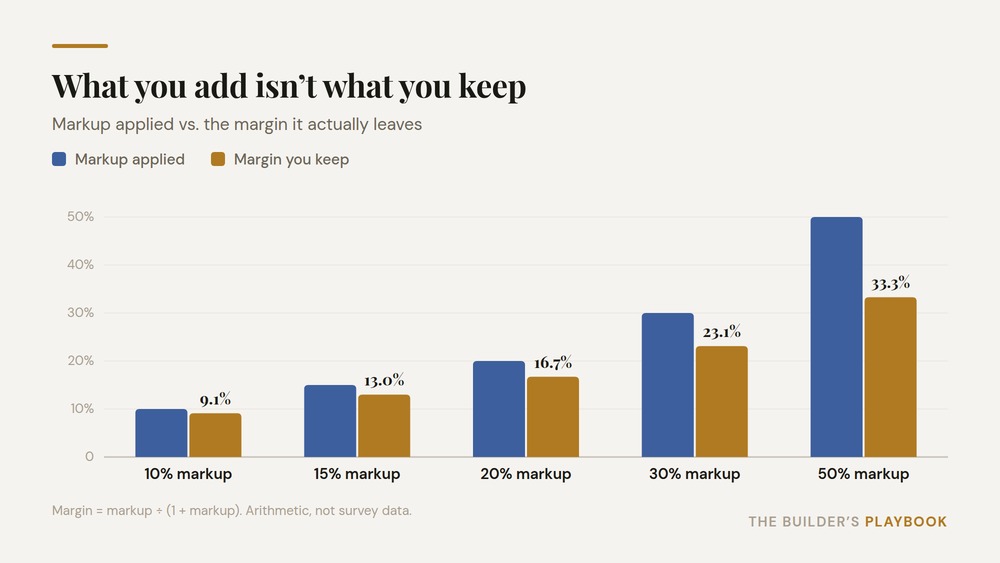
And it usually gets worse than that, because the ten thousand of "cost" was probably understated in the first place. If you priced the labour at the bare wage instead of the true cost of an hour of your crew's time — the burden, the truck, the downtime between calls — your real cost was higher than ten grand, and your real margin on cost-plus-ten was even thinner than the nine percent I just described. The mistakes stack, and that's usually where the margin quietly disappears.
Finding Your Actual Number
The right markup isn't a number you look up. It's a number that falls out of your own business when you build it honestly, and it comes from three things: your real cost, your overhead, and the profit you've decided the business needs to make.
Start with the overhead. Add up everything that goes out the door in a year that isn't tied to a specific job — rent, insurance, admin wages, your fleet, software, your own time spent running the business instead of working in it. Your year-end statements will hand you most of that total, though they won't tell you which jobs carried it and which ones didn't — that's what your P&L isn't telling you about a job. That total has to get recovered across your work. Then decide, on purpose, what profit you want on top of it. Now you know the margin you need your revenue to hold, and from there it's arithmetic to convert that margin into the markup that produces it — which is where the difference between markup and margin stops being a technicality and becomes the difference between the number you apply and the number you keep.
When contractors actually run this, the answer almost never comes back as ten percent, and it rarely comes back as a round number at all. It comes back as their number, and it usually surprises them how much higher it needs to be than what they've been charging. That's not a licence to gouge anybody. It's just the honest price of running the business they're actually running. It's one piece of a bigger pricing formula, and it ties straight back to your break-even number — because until the markup covers your overhead, you haven't made money, you've just been busy.
Do You Mark Up Subs and Materials?
The other half of this question isn't what percentage — it's what you apply it to. And the answer that catches people out is that everything moving through your business gets marked up, not just the hours your own crew works.
Subcontractors are the one contractors hesitate on. It feels like charging for someone else's work. It isn't. When a sub's invoice comes through you, you're the one who found him, scheduled him, coordinated him around the other trades, checked his work, carried the warranty on it in front of the client, and paid him on your terms while you waited on a draw. If that sub walks off halfway through, it's your problem and your reputation. All of that is real work and real risk, and passing his number through at cost means you did every bit of it for free.
Materials are the same story in a different shape. You're financing them ahead of the draw, storing them, eating the ones that get damaged or stolen, chasing the backorder, and making the second supplier run when the count was short. A markup on materials isn't a surcharge for handing over lumber — it's the cost of being the one responsible for the lumber being there.
Permits and municipal fees are the reasonable exception. Most contractors pass those through at cost and list them plainly, and clients read that as honest, which it is.
One Markup, or Different Ones by Job Type?
Start with one blended number. It's simpler, you'll actually apply it consistently, and consistency beats precision when you're getting this habit going.
Once it's running, though, it's worth letting risk move the number. A renovation in a 1950s house where you can't see behind the walls carries a different kind of exposure than a new-build deck where everything is known going in, and the price should say so. Service work is its own case — lots of small tickets, lots of drive time, a dispatch cost on every call — and it usually needs a higher markup than a job where the crew is on one site for three weeks straight.
None of that is complicated. It's just refusing to charge the same for work that doesn't carry the same risk.
"Ten percent isn't a strategy. It's a number somebody borrowed from somebody else and never checked against their own business. Yours is in your own books, waiting to be worked out."
The Bottom Line
The right markup for a contractor is the one that covers your overhead and leaves the profit you decided on, built from your real costs. For most people that number is meaningfully higher than the gut-feel percentage they've been carrying, and finding it is one of the fastest wins there is — because unlike hiring or winning more work, it doesn't cost you anything to charge what the job is actually worth.
If you've never sat down and worked out your real number — the one that comes from your overhead and your labour burden rather than from a rule of thumb you inherited — that's exactly the kind of math I sit down and do with contractors through my construction business coaching. It's usually where the profit was hiding all along.
Quick answers
How much should a contractor mark up?
There's no single correct number — the right markup is whatever covers your overhead and leaves your target profit on top, and that depends on your own fixed costs and how you've counted your labour. A shop with heavy overhead needs a bigger markup than a lean one to hit the same take-home. Anyone who quotes you a universal 'contractors should mark up X%' is guessing at your business.
Is a 10% markup enough for a contractor?
Almost never. Ten percent markup is only about a 9% margin, and for most contracting businesses that won't even cover overhead once it's counted honestly — which means the profit line is negative before you've paid yourself as the owner. 'Cost plus 10' is one of the most common ways a busy contractor stays broke.
How do I find the right markup for my business?
Work backward. Add up your annual overhead and the profit you want the business to make, express that as the margin you need on your revenue, and convert that margin into the markup that produces it. The number that falls out is your markup — built from your actual costs, not borrowed from someone else's business.
Get The Builder's Playbook in your inbox
A short note from Eddy with a link to the week's post — one email a week, every Thursday, nothing else.
No spam. Unsubscribe with one click any time. Privacy policy.
This site is protected by reCAPTCHA and the Google Privacy Policy and Terms of Service apply.