
I had a contractor tell me once, dead serious, that he ran a 20% margin on his work. Good operator, clean job sites, happy clients. I asked him how he priced, and he said he took his cost and added twenty percent. And I had to be the guy who told him that what he'd just described wasn't a 20% margin — it was a 20% markup, and his actual margin was closer to sixteen and a half.
He didn't believe me at first. Nobody does, the first time. It sounds like a technicality, like I'm splitting hairs over which percentage to call it. It isn't. On a business doing a couple million a year, the gap between the margin he thought he had and the one he actually had was tens of thousands of dollars he was never seeing — and he'd been leaving it on the table for years without knowing.
This is one of those things that never got taught. You learned your trade. You didn't take a class on the difference between calculating a percentage on your cost versus calculating it on your price. So let me do it here, because it's genuinely one of the most expensive misunderstandings in the trades, and it takes about five minutes to fix for good.
Two Numbers, Two Different Starting Points
Markup and margin are both percentages, and they can both describe the exact same job with the exact same dollars in it. The difference is what you measure the percentage against.
Markup is measured against your cost. If a job costs you ten thousand dollars and you mark it up 25%, you add twenty-five hundred and charge twelve-five. The markup is 25% because twenty-five hundred is a quarter of your ten-thousand cost.
Margin is measured against the price. On that same job, you charged twelve-five and kept twenty-five hundred of it. But twenty-five hundred is only 20% of twelve-five. So your margin is 20%, not 25% — same job, same dollars, smaller percentage, because you're measuring it against the bigger number.
That's the whole thing. Markup looks up from your cost. Margin looks down from your price. And margin is always the smaller of the two, because the price is always bigger than the cost.
Why the Gap Matters More Than It Sounds
Here's why this isn't hair-splitting. The margin is the number that actually tells you how the business is doing, because it's the share of what you charged that stayed with you. When a benchmark says a healthy construction business runs a certain net margin, that's a margin number — measured against revenue. If you're walking around thinking your 25% markup is a 25% margin, you're comparing yourself to the wrong line and feeling better than you should.
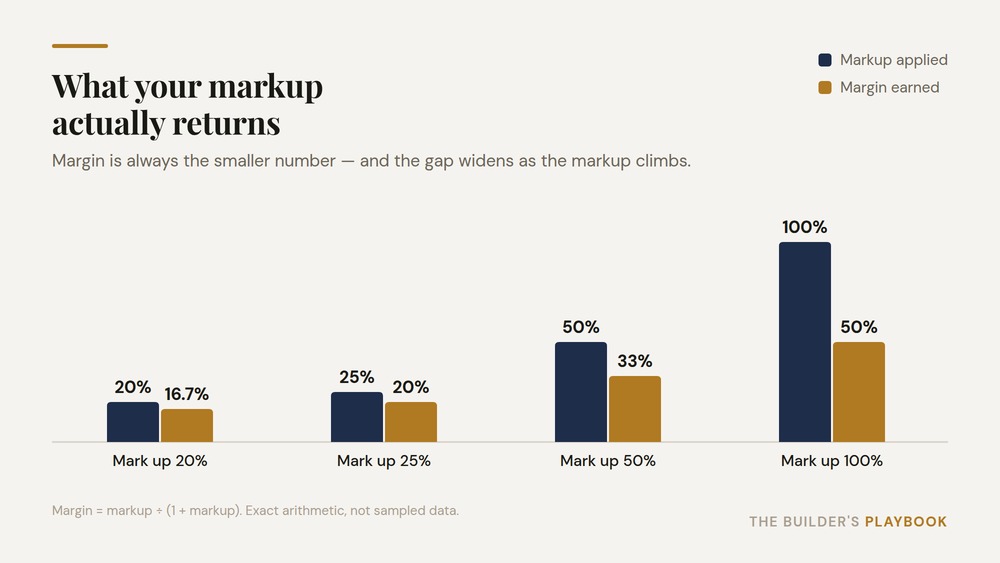
And the gap gets wider the higher you go, which is the part that surprises people. A 20% markup is about a 16.7% margin. A 25% markup is a 20% margin. A 50% markup is only a 33% margin. Push it to a 100% markup — doubling your cost — and you're still only at a 50% margin. Every step up, the two numbers spread further apart, and the contractor who's tracking the wrong one gets more and more wrong about where his business actually sits.
I've seen this one line up almost perfectly with the margin that was too thin going in on job after job. The owner isn't losing the money during the work. He lost it in the estimate, the day he confused the two numbers and priced to the wrong one. I've made that kind of mistake myself, on the estimate that cost me twenty-two thousand dollars, and the lesson was the same: the job didn't go wrong, the number did.
What the Gap Costs Over a Full Year
On one job, the difference between a 20% markup and a 20% margin is a few hundred dollars, and that's exactly why it survives so long without anyone catching it. Nobody blows up a business over a few hundred dollars. But you don't run one job a year.
Take that contractor I mentioned, the one putting a couple million through the company. He thought he was keeping twenty cents out of every revenue dollar. He was keeping about sixteen and a half. Run that across a full year of work and the gap between the number he believed and the number he had comes to more than a good foreperson's wage — sitting there the whole time, in every quote he'd written for years.
The reason it hides so well is that nothing about it feels like a loss. There's no bad debt, no write-off, no callback eating your Saturday. Every job comes in roughly where you said it would. The work is good, the clients are happy, and the money is quietly less than you think, which is how this runs for a decade without anybody noticing. It's the kind of leak that only tracking gross margin by project ever surfaces, because nothing else in the books looks wrong.
How to Price So Your Margin Is What You Think It Is
The fix is to decide in margin and then work backward to the markup you'll actually apply. Start from the margin the business needs — the share of revenue that has to stay in to cover what a markup so often forgets, which is real overhead recovery and real profit, not just your own wage. Then convert that target margin into the markup that produces it, and price with that markup.
The conversion is simple arithmetic, and once you've done it for your own target you rarely have to think about it again. If you need a 25% margin, you don't mark up 25% — you mark up about 33%. If you need a 33% margin, you mark up 50%. You can build this into a one-line calculation in whatever you quote with, so the markup you apply is always the one that lands you on the margin you actually decided on. This is a piece of how to price a construction job so it holds up, and it pairs directly with knowing what you should actually be marking up in the first place, because the right markup on the wrong cost still gets you nowhere.
"Markup looks up from what the job cost you. Margin looks down from what you charged. You feel the first one. You live on the second one."
The Discount That Costs More Than You Think
Once you're thinking in margin, the discount conversation changes completely, and this is where the arithmetic bites hardest.
A client asks you to come down ten percent. It sounds like a small ask, and if you're thinking in markup it feels like you're giving up a tenth of your bump. You're not. You're giving up ten percent of the price, and that comes straight out of the only part of the price that was ever yours. On a job priced to a 20% margin, taking ten percent off the number doesn't leave you at ten. It leaves you at about eleven. You've handed over half your margin so the client could save a tenth of their bill.
Do that on a job that was already priced thin and you're working for the experience. I've watched contractors give a discount in a driveway conversation, in about four seconds, that wiped out more profit than the change order they'd argued over for a week. If you know your margin cold you know what a discount costs before you offer it, and you can answer with something other than a number — a smaller scope, a longer schedule, a different material spec — instead of taking it out of your own pay.
"Knock ten percent off the price and you don't lose ten percent. You lose half your margin, in four seconds flat."
The Bottom Line
You can't manage a number you're measuring wrong. If you've been pricing on a markup and calling it your margin, you've been quietly running thinner than you believed, on every job, for as long as you've done it that way — and the frustrating part is that the work was fine. The leak was in the arithmetic, before the first material order went in.
Fix it once. Figure out the margin your business actually needs, convert it to the markup that produces it, and price to that from now on. It's the kind of five-minute correction that changes what your whole year looks like — and it's usually the very first thing I check when a contractor tells me the revenue's there but the profit isn't. Knowing your numbers cold is where every one of those conversations starts, and it's exactly the work I do with owners at Tumbleweed Consulting.
Quick answers
What's the difference between markup and margin?
Markup is calculated on your cost. Margin is calculated on the price you charge the client. If a job costs you $10,000 and you add 25% markup, you charge $12,500 — but your margin on that $12,500 is only 20%, not 25%. Same dollars, two different percentages, because they're measured against two different starting numbers.
If I mark up 20%, what's my margin?
About 16.7%. A 20% markup on cost produces a margin of roughly 16.7% of the selling price. Marking up 25% gives you a 20% margin; a 50% markup gives you a 33% margin. The margin is always the smaller number, and the gap widens as your markup grows.
Should contractors price on markup or margin?
Think in margin, because margin is what actually lands in the business. It's fine to apply the price using a markup, as long as you've worked backward from the margin you need. The danger is picking a markup number that feels healthy and assuming it's your margin — it isn't, and the difference is real profit you never see.
Get The Builder's Playbook in your inbox
A short note from Eddy with a link to the week's post — one email a week, every Thursday, nothing else.
No spam. Unsubscribe with one click any time. Privacy policy.
This site is protected by reCAPTCHA and the Google Privacy Policy and Terms of Service apply.