
I spent real money — I won't tell you the exact number, but it was significant — on a project management platform about four years into running the business. The problem we were solving, as I framed it at the time, was reporting. Projects were running over budget in ways nobody was catching until it was too late to do anything about it. By the time I found out a project was ten percent over, the money was already gone.
The solution, I decided, was better software. More visibility, better dashboards, data coming in from the field faster and in a more usable format. I found a platform that fit the problem, got it implemented properly, trained the team on it, and waited for the reporting problem to get better.
The reporting got marginally better. The actual problem didn't move at all.
What I Was Refusing to See
The issue was not the software. I'd known this, somewhere underneath the excitement of buying a solution, for a while before I admitted it. The issue was that my project managers didn't have a shared, clear understanding of what they were supposed to report, how often, and with what level of financial granularity. There was no explicit expectation. Nobody had ever sat down with them and said: at the end of every week, this specific information goes into the system, in this format, flagging anything that has moved more than this percentage off budget.
Without that clarity, the platform was just a more expensive place to not report things. The information that wasn't going into our spreadsheets didn't suddenly start going into the new software. Why would it? The behaviour hadn't changed. Only the container had.
That's the thing about software: it amplifies what's already there. It doesn't create clarity where there is none. It doesn't create accountability where there's been none modelled. It doesn't make a team communicate consistently if they haven't been communicating consistently. A disorganized business running on a whiteboard and a group text is a disorganized business. A disorganized business with a $15,000-a-year enterprise platform is still a disorganized business — it just has a more expensive and harder-to-change operating environment. Why small contractors stay small even when they're busy often has this pattern embedded in it: the search for a tool that will solve what is actually a leadership and clarity problem.
"Software amplifies what's already there. Put it on top of unclear expectations and you get a more expensive, harder-to-fix version of the same problem."
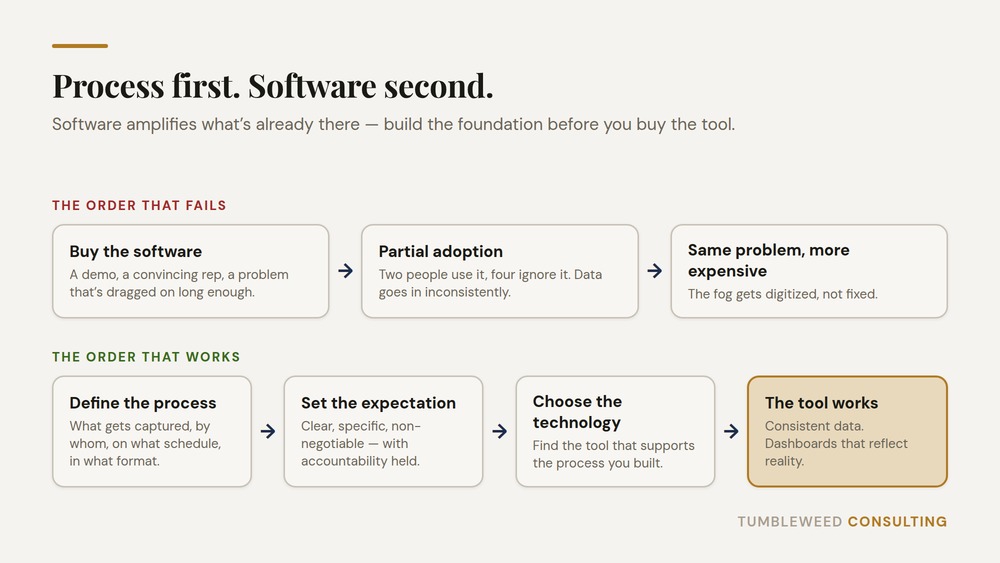
The Expensive Lesson in the Right Order
What fixed our reporting problem was not the software, or not primarily the software. What fixed it was a conversation I had with my PMs about exactly what I needed from them, every week, in specific terms. Not "keep me updated on budget" but "every Friday, this data, in this format, with a flag on any line item more than eight percent over projection." Clear, specific, non-negotiable.
That conversation, and the follow-through when people didn't do it, solved the problem. The software then became genuinely useful because we'd defined what useful meant. The data went in consistently because the expectation was clear and being held. The dashboards started reflecting reality instead of reflecting whatever partial information happened to get entered.
I tell this story to contractors regularly, and most of them recognize it. They've bought the CRM that hasn't been adopted. They've implemented the scheduling platform that two people use and four people ignore. They've tried the field communication app that lasted six weeks before everyone went back to texting. The pattern is always the same: the technology wasn't the problem, so the technology wasn't the solution.
What delegation actually requires before it works is exactly this: people who understand clearly what they're responsible for, what good looks like, and that there's accountability attached to the expectation. Software doesn't provide any of those things. A direct conversation, modelled consistently, provides all of them, and the technology becomes an enhancement once that foundation exists.
Diagnosing Whether You Have a Process Problem or a Tool Problem
The question to ask before any technology investment is: can your team describe, clearly and without disagreement, what this software would need to do? Not what features they'd use or what problems they hope it solves — what specific information needs to be captured, by whom, on what schedule, in what format, and what happens when someone doesn't do it?
If you ask that question to your team today, without the software in the room, and the answer is fuzzy or inconsistent, you don't have a tool problem. You have a process and clarity problem. Buying the software before solving that will produce the result I got: a technology implementation built on a foggy foundation, which digitizes the fog rather than resolving it.
If the process only lives in someone's head is where most small construction businesses are when they start looking for software solutions. One person knows how the project tracking is supposed to work. Another person has a different mental model. A third person isn't really sure. When software goes on top of that, each of those people uses it differently, the data becomes inconsistent, and the dashboard you bought for visibility becomes another thing you can't trust.
The diagnosis takes maybe a few hours of honest conversation. What does the team understand about their responsibilities in this process? Where do the understandings diverge? What's not being defined that everyone's been assuming? The answers are almost always instructive, and sometimes they reveal that the problem you thought you needed software to solve is actually a communication or expectations problem that costs nothing to fix. The same diagnosis applies outside your own payroll — a sub who doesn't show up is usually an expectations gap rather than a character flaw, and no scheduling platform closes that gap for you.
When Technology Is the Right Answer
I want to be clear that I'm not anti-software. The right tools, implemented in the right order, genuinely help a construction business operate at a higher level. Scheduling platforms that give the whole team visibility into the same information. Estimation software that standardizes how bids get built and reduces the chance of missing a category. Field-to-office communication tools that reduce the game of telephone that happens on multi-site operations. These are real improvements, and the businesses that use them well are more efficient and more scalable than those that don't.
The operative phrase is "implemented in the right order." The order is: define the process clearly, establish the expectation and the accountability, and then find the technology that supports what you've built. Not: find the technology and hope the process figures itself out around it.
When a job goes over budget without anyone catching it early is the outcome of skipping the process step. The information exists somewhere in the business, in someone's head, in a job site notebook, in a text thread nobody's reviewing, but there's no system that brings it forward in time to act on it. Technology can build that system. But first someone has to define what the system is supposed to surface, when, and what happens when it does.
The Pattern I See Every Year
In the construction businesses I work with, the technology investment almost always happens before the process work. An owner sees a competitor using a new platform. A sales rep makes a convincing presentation. A problem has been frustrating long enough that buying something feels like action. The investment happens, the implementation is imperfect because the underlying clarity isn't there, adoption is partial, and in eighteen months the owner is either still using a version of the old system alongside the new one or looking at the next solution.
The businesses that break this pattern, that do the process and people work first, then implement technology deliberately on that foundation, get dramatically better results from the same tools. Not because the software is different. Because the people using it know clearly what they're supposed to do with it and why it matters.
The Bottom Line
Before you evaluate the next platform that promises to solve your operational problems, spend an afternoon getting clear on what you actually need it to do. Define the process. Define the expectation. Define what success looks like when it's working. If your team can describe all of that consistently without the software, you're ready to find the tool. If they can't, that's your real problem, and no software will solve it for you.
The process work is less exciting than the software demo. It doesn't have a features list or a trial period. But it's the work that makes everything else work, and it's the order that actually produces results. If you want help identifying where the process and people gaps are in your business before your next technology decision, that's exactly the kind of work I do with trades and construction owners through my construction business coaching. The answer is almost always simpler than you're expecting, and considerably cheaper than the software you were about to buy.
Quick answers
Why doesn't new software fix operational problems in construction companies?
Software amplifies what already exists. If your team has clear expectations, consistent accountability, and communicates well, the right software helps you do more of that more efficiently. If the team lacks clarity on expectations or avoids accountability, new software gives you a more expensive and slightly more complicated version of exactly the same problem. The tool can't substitute for the underlying clarity it depends on to work.
What should a construction company do before investing in project management software?
Get very specific about what the software needs to do: what information it captures, by whom, on what schedule, and what 'working' looks like in practice. If your team can't answer those questions clearly today without the software, start by solving the clarity and expectation problem first. The technology investment will produce far better results when built on that foundation.
In what order should a trades company address process, people, and technology problems?
Process and people first, always. Define what the work should look like and who is responsible for what. Build the expectation and accountability structure. Then find the technology that supports the process you've built. Implementing technology on a broken process doesn't fix the process — it digitizes it, which makes the underlying problem harder to address because now there's a system creating the illusion that structure exists.
Get The Builder's Playbook in your inbox
A short note from Eddy with a link to the week's post — one email a week, every Thursday, nothing else.
No spam. Unsubscribe with one click any time. Privacy policy.
This site is protected by reCAPTCHA and the Google Privacy Policy and Terms of Service apply.