
I had a framer on a crew a few years ago who kept setting window openings slightly high. Not dramatically wrong. Wrong in the way that looked fine until the windows were ordered and showed up on site. We'd been through the correction twice, the third time was coming, and I was genuinely frustrated. I pulled him aside, ready to have a direct conversation about standards, and I asked him: how were you taught to calculate rough opening height at the last place you worked?
His answer stopped me. Because it was completely logical, consistent with what he'd been taught, and completely at odds with how we did it. Nobody had told him we did it differently. He'd been doing it exactly right by the rules he knew. I'd just never given him our rules.
That conversation ended my frustration and got me thinking differently. The problem wasn't him. The problem was that I'd hired a competent person, pointed him at the work, and assumed that a competent person would naturally arrive at my standards. That assumption cost me three call-backs and a half-day of rework. Multiplied across every new hire I'd onboarded that way over ten years, the number got uncomfortable fast.
What "Watch and Learn" Actually Teaches
On-the-job training is what most construction companies call the absence of training. You drop a new hire into a working crew, pair them, loosely, with someone senior, and the understanding is that they'll absorb the correct approach through observation and proximity. It works, eventually, the way water works on sandstone: given enough time and repetition, the shape will emerge. But in the meantime, you get inconsistency, you get the habits of whoever they happened to be standing next to, and you get the accumulated cost of learning by getting it wrong.
The honest version of "watch and learn" is this: watch whatever you happen to see, learn whatever habits your mentor happens to have, and hope they align with what this company actually expects. Sometimes they do. Sometimes the person you paired the new hire with has shortcuts of their own that you never sanctioned but also never explicitly challenged. And now you've accidentally certified those shortcuts as the way we do it here, because nobody ever said otherwise.
It's the same problem I see when the knowledge that runs a company lives only in someone's head. In most small construction companies, the standards and processes that produce quality work live in the heads of one or two experienced people: the owner, the lead hand, maybe one reliable foreperson. When a new hire lands in a crew and those people are busy or unavailable, the knowledge doesn't transfer. It just sits there, inaccessible, while the new person makes decisions based on their previous employer's way of doing things.
The Three Changes That Actually Made a Difference
The changes I made when I finally got serious about this weren't dramatic and didn't cost much. What they required was intentionality: sitting down and making explicit the things I'd been leaving implicit.
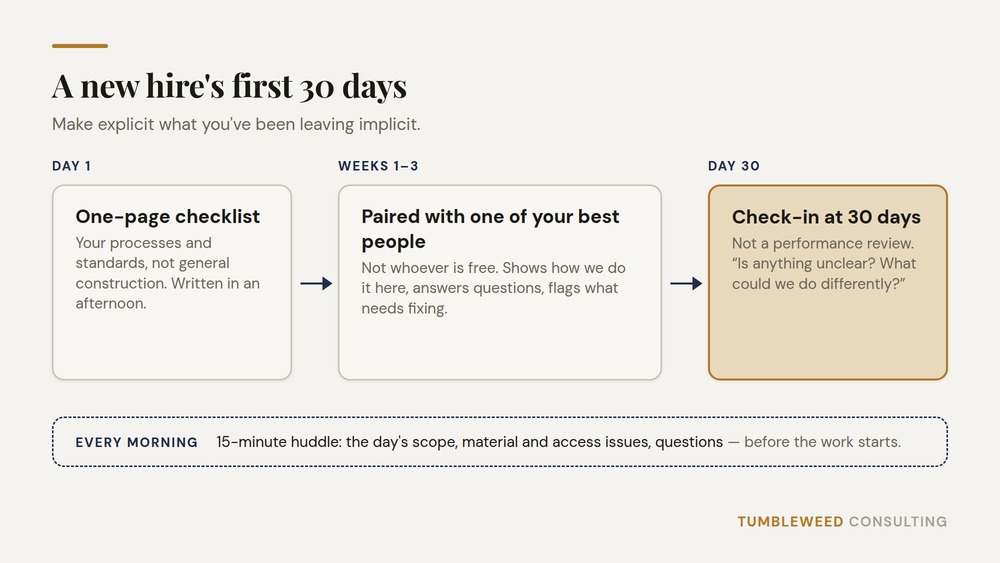
The first change was a one-page first-week checklist. Not a manual, not a binder, not a formal training curriculum. A single page covering what a new person needed to know to function in our environment from day one: our process for labelling materials, how we prep a site at the end of each day, our procedure for flagging a problem to the superintendent rather than guessing and hoping, and the names and roles of the people they'd be working with most. Things that seem obvious to anyone who's been there a year and are completely opaque to someone on their first week. Writing it took an afternoon. Not having it had cost me years of repeated corrections on things I'd assumed people would just know.
The second change was deliberate pairing. Instead of putting a new hire with whoever was available or whoever had the lightest current workload, I put them with one of my best people for the first two to three weeks, explicitly. Not as a mentorship program with a capital M. Just a clear understanding that this person is responsible for showing the new hire how we do things, answering questions without making them feel like idiots for asking, and flagging anything they noticed that needed addressing. This sounds obvious. It isn't standard practice. Most foremen are too busy keeping their own work on track to take on the informal mentoring that watch-and-learn assumes is happening.
The third change was the 30-day check-in, which turned out to be the highest-return item on the list. Not a performance review. I'm explicit about that because performance reviews make people defensive and close down the conversation. A genuine check-in: how is it going, is there anything that's been unclear, have you noticed anything that you think we could do differently. That last question, asked honestly and actually listened to, catches training gaps before they've calcified into performance patterns. It also tells a new hire this is the kind of company that actually wants their perspective, and that's a retention signal that costs nothing to send.
"The crew doesn't create the deficiencies. The absence of clear instruction creates the conditions in which deficiencies are inevitable."
Writing Down What Everyone Assumes Is Already Known
The most consistently useful thing in the whole process was documenting the basics of how we do things, not the technical construction knowledge but our specific operational habits. How materials get labelled on our sites. What our end-of-day site condition standard actually is. How a change order conversation gets handled when a client brings up a scope addition in the field. When and how to communicate a problem up the chain rather than trying to solve it alone.
These things feel obvious to anyone who's been at the company for three years. They are completely invisible to someone who arrived last Tuesday. And when you leave them invisible, what fills the gap is whatever the new hire was trained to do at their last employer, which might be fine or might be subtly at odds with your standards in ways that compound over weeks before anyone notices.
The person you keep correcting is often running on training you never gave them, and that's more uncomfortable to admit than most owners want it to be. It's the same lesson I learned about handing work off and then stepping back: you can't hold someone to a standard you never actually showed them. Because if the training problem is yours to solve, the rework problem is also partly yours. The crew is doing what they know how to do. The question is whether you've taught them your way of doing it or just hoped they'd arrive at it on their own.
Writing it down takes time you don't feel like you have. Not having it written down costs you repeated corrections and foreman sanity and callback rate and the morale that comes from being corrected on something nobody ever actually told you. That cost doesn't show up cleanly on a line item, but it absolutely shows up in margin, and it shows up in who stays. A new hire who gets corrected on rules nobody gave them is sending you the small signals a good tradesperson sends long before they quit.
The Morning Huddle That's Worth Every Fifteen Minutes
One more piece of the process that took longer to value than it should have: the daily morning huddle. Fifteen minutes before the day starts to cover the day's scope, flag any material or access issues, and give people a chance to ask questions before they're working from incomplete information.
The return on fifteen minutes of morning alignment is enormous compared to the cost of a crew spending their first hour working from assumptions about what the plan is, or waiting for direction from a foreman who's dealing with a supplier phone call. It also creates a daily rhythm where questions are expected and normal rather than a sign of weakness or ignorance, which changes the rate at which problems surface early versus late. Early is always cheaper than late. In construction, always.
The Bottom Line
The crew you have is largely the crew you've built through the quality of your training and the clarity of your expectations. A competent person with unclear expectations produces inconsistent results. A competent person with clear expectations, proper pairing, and a genuine check-in at thirty days produces consistent quality and stays longer, because they feel like someone actually set them up to succeed.
You can't build a great crew by accident any more than you can frame a house by accident, and a crew culture that holds when you're not on site starts with the first week someone spends with you. If you want help putting together a simple onboarding and training process that fits your size and doesn't need a training department, that's work I do with owners one-on-one. Learn more about my business coaching for contractors.
Quick answers
What does an effective construction onboarding program actually include?
At minimum: a one-page checklist for the new hire's first week covering your specific processes and standards (not general construction knowledge), pairing with one of your best people rather than whoever is available, a daily or weekly touchpoint to catch confusion early, and a 30-day check-in conversation that asks genuine questions and actually listens to the answers. None of this requires a formal training department — it requires intentionality and about a week's worth of prep time.
How does poor onboarding lead to rework in construction?
Most rework doesn't come from incompetent tradespeople. It comes from competent people operating from incomplete or incorrect assumptions about how this specific company does things. When you assume a new hire already knows your standards, your sequencing preferences, your quality benchmarks, and who to call when something is unclear, you're setting up the conditions for mistakes that cost you twice — once in the deficient work and once in fixing it.
How long does it take to see the impact of a better training process?
The first place you'll see it is the 30-day check-in, because that's where the gaps surface while they're still cheap to fix. The savings come from catching confusion early, before it hardens into a habit you have to correct on every job.
Get The Builder's Playbook in your inbox
A short note from Eddy with a link to the week's post — one email a week, every Thursday, nothing else.
No spam. Unsubscribe with one click any time. Privacy policy.
This site is protected by reCAPTCHA and the Google Privacy Policy and Terms of Service apply.