
I remember sitting down with one of my project managers after he'd lost a quote we should have won. The client had liked the work, liked him personally, said he'd be in touch, and then signed with someone else.
I asked him how the site visit had gone, what questions he'd asked, how he'd presented the proposal. He walked me through it. It wasn't bad. But it also wasn't what I would have done, and there was nothing I could point to and say "here's where it went wrong," because there was no shared version of what "right" looked like. There was just my way, which I'd never written down, and his way, which was a reasonable guess at something he'd never been properly taught.
That conversation made me realize the problem wasn't him. The problem was that for years, our sales process had lived entirely in my head, and I'd been calling that a system.
What Happens When the Owner Is the Sales Team
For most of the early years, I handled the sales conversations personally. That worked well enough. I knew our work, I knew how to read a client's real concerns, I knew when to talk about price and when to talk about what would happen if they chose someone cheaper. My close rate was reasonable and I assumed that was because I was a decent salesperson.
What I didn't understand was that my close rate wasn't just about how I talked to clients. It was the result of patterns I'd built up through years of those conversations: specific questions I always asked, a specific way I handled the price objection, a follow-up timing I'd refined through trial and error without ever calling it a method. None of that was transferable in the form it lived in, which was inside my head and visible only in the outcomes.
What actually differentiates you in a competitive sales conversation is rarely the thing you think it is. For us, a big part of it was the quality of the discovery conversation — the questions we asked in the first meeting that made a client feel heard in a way our competitors probably didn't. When I was having that conversation, we captured that advantage automatically. When someone else was having it without knowing that's what was happening, we gave the advantage away.
The business that can only sell when the owner is in the room is fragile in ways that aren't visible until you actually need to step back. And every business owner eventually needs to step back. An illness, a stretch of heavy operational focus, or simply the fact that you can't be in every sales conversation once the business grows. When that moment arrives and the process lives only in your head, the pipeline dries up in ways that are hard to diagnose and harder to fix in a hurry.
What a Process Actually Looks Like for a Trades Company
When people hear "sales process" in a construction context, they sometimes picture something corporate and complicated: a CRM, a multi-stage funnel, a playbook nobody will read. What a sales process actually is, for a trades company, is a lot simpler than that.
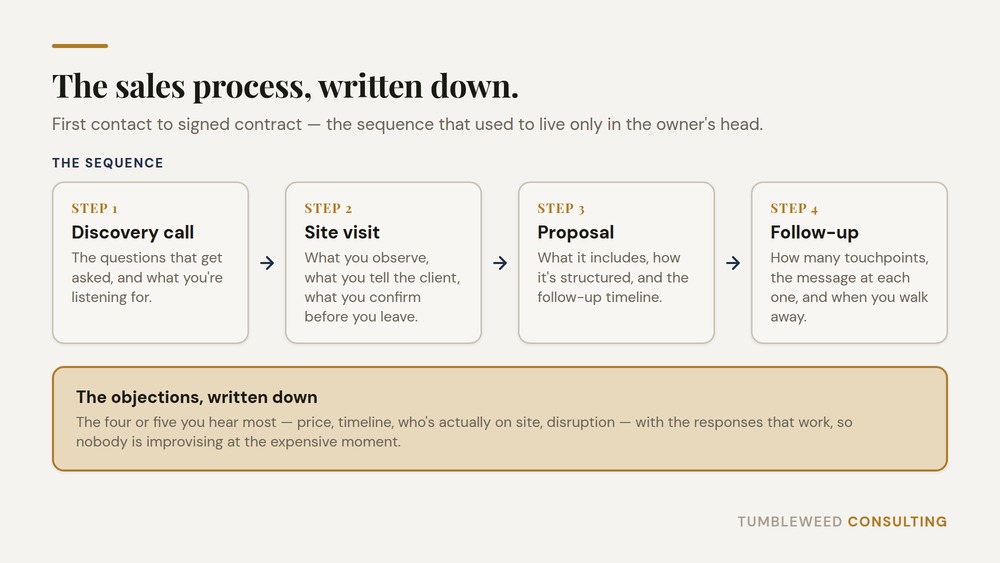
It's a defined sequence of steps from first contact to signed contract. Discovery call structure: what questions get asked and what you're listening for. Site visit protocol: what you observe, what you communicate, what you confirm before you leave. Proposal format: what it includes, how it's structured, what the follow-up timeline looks like. The four or five objections you hear most often, written down alongside the responses that work best. That's most of it.
When we mapped this out for the first time, two things happened. The first was that writing it down forced me to actually think about what I was doing in these conversations, rather than just doing it. That exercise alone surfaced a few things I'd been doing on instinct that turned out to matter, and it showed up a couple of gaps I'd been filling with improvisation at exactly the moments when improvisation was most expensive. The second was that the next time my project manager walked into a first meeting, he had the same questions in front of him that I would have asked, and the conversation we had afterward was about what the client had said instead of what he'd guessed at.
"For years, I called the way we won jobs a sales process. It wasn't — it was a set of habits that lived in my head and were visible only in the outcomes."
When the sales gap becomes a cash flow problem, you don't have time to rebuild your approach from scratch. A defined process means whoever is handling the conversation has a consistent foundation to work from, even when conditions are difficult.
The Difference Between Personality and Process
One objection I hear from trades owners when this comes up: "My clients buy from me because of the relationship, and you can't put a relationship in a template." That's true, and it's also not what a sales process is trying to do.
A sales process isn't about taking the personality out of the conversation. The relationships and credibility that make your sales work don't disappear when you frame them. What a process does is make the habits behind the outcomes repeatable. The discovery questions that make clients feel heard work because of the relationship they build in the moment, and a process just makes sure they get asked every time. The follow-up timing that keeps you top of mind works because it feels attentive, and a process makes sure it happens reliably rather than when you happen to remember.
The goal is to capture the things that are working and make them happen consistently, whether it's the owner in the room or a trained project manager.
What happens when knowledge lives in one person's head is, in sales, usually that it disappears the moment that person is unavailable, takes a holiday, or leaves the business. The relationship can't always be replicated. The habits that support it absolutely can be, once they're written down.
Building It the Right Way
The most practical way to start is to write down what you currently do, step by step, even if you're not sure all of it is worth keeping. Discovery call: how long, what questions, what outcome. Site visit: what's the checklist, what do you tell the client before leaving, what triggers a follow-up. Proposal: format, timeline, how you present it. Follow-up: how many touchpoints, what's the message at each stage, when do you walk away.
Then look at the close rate by stage. Where are you losing jobs? Is it after the discovery call, where they never move to a site visit? After the proposal, where you're not getting a response? Is the follow-up inconsistent? The process makes those questions answerable, which is what makes improvement possible. Why most small contractors stay small often comes down to not being able to improve anything systematically, because without a process you can't tell where the problem is.
It's also worth getting honest about the objections you hear most often. Price is the obvious one. But beyond price there are usually two or three more: timeline concerns, questions about who will actually be on site day to day, worry about disruption. Write down the objections and the responses that work. Train the person who handles sales conversations to use them. The improvised response works fine when you're the one giving it after twenty years of practice. It doesn't work nearly as well for someone who hasn't had that practice and has nothing written down to fall back on.
"The process already exists. You're just the only one who has it."
The Bottom Line
A trades business where only the owner can close deals has a growth ceiling built in. Not because the owner isn't good at sales (they usually are), but because it's a dependency that can't scale, and it creates fragility in every direction: growth, vacation, illness, eventual succession. The fix isn't complicated. It's writing down what works, turning it into a teachable sequence, and then actually teaching it.
If you've been the only one who can really close jobs and you know it's a problem you've been putting off, that's one of the most straightforward things to fix in a trades business, because the process already exists. You're just the only one who has it. Getting operational systems like this out of an owner's head and into the business, where a team member can actually run them, is exactly what my construction business coaching is built around.
Quick answers
Why do contractors struggle to scale their sales beyond the owner?
Most trades business owners win jobs through personal relationships and intuition built over years in the field. That knowledge isn't written down, so there's nothing to teach someone else. The owner becomes the required ingredient in every sales conversation, which creates a hard ceiling on growth and a dependency that makes the business fragile.
What should a construction company's sales process include?
At minimum: a structured discovery call with consistent questions, a site visit checklist, a defined proposal format with clear timelines, a follow-up cadence, and documented responses to the four or five objections you hear most often. The goal isn't to make sales feel scripted — it's to make the reliable habits repeatable regardless of who's executing them.
How does documenting a sales process improve close rates?
When you stop improvising at critical moments in the sales conversation, you get more consistent execution. The discovery questions that build trust, the proposal format that addresses real concerns, the follow-up timing that keeps you top of mind — these work reliably only when they're done consistently. A documented process is what makes consistency possible.
Get The Builder's Playbook in your inbox
A short note from Eddy with a link to the week's post — one email a week, every Thursday, nothing else.
No spam. Unsubscribe with one click any time. Privacy policy.
This site is protected by reCAPTCHA and the Google Privacy Policy and Terms of Service apply.