
I spent the first several years of running my own operation handing detailed, honest proposals to clients and then waiting politely for them to get back to me. Sometimes they did. Often they didn't. When they didn't, I told myself they'd found someone cheaper, or the timing wasn't right, or they'd decided not to do the project. What I wasn't telling myself was the simpler truth: I was terrible at asking for the business, because asking felt like something that belonged to the used car lot.
It took a long time, and a lot of walked-away work, before I understood that I had conflated closing with manipulation — and that the discomfort I felt was about bad sales tactics, not about the act of asking for a decision.
The Source of the Discomfort
Most trades guys who struggle with closing aren't struggling because they can't handle a conversation. They're struggling because every sales training they've ever encountered was built around pressure: urgency that doesn't exist, bonuses that disappear at midnight, manufactured scarcity, "let me check with my manager" scripts. They learned to associate the word "closing" with a version of selling that felt dishonest, and they decided they weren't willing to do it that way.
That's actually a healthy instinct. The problem is what they did with it. Instead of rejecting the bad techniques and finding a more honest version of the conversation, most of them rejected the act of asking altogether. They'd do the site walk, produce the estimate, answer the questions, and then hand over the proposal and go quiet, waiting for the client to choose them or not. Which is essentially asking the client to close themselves, and hoping they do.
The discomfort isn't about selling. It's about a version of selling that trades people have every reason to dislike. The version that actually works — the one that doesn't feel manipulative to either party — is completely different, and most of them have never seen it modeled.
What Closing Actually Is
Closing is asking for a decision from someone who has enough information to make one. That's the whole thing. Strip away every technique, every script, every manufactured urgency play, and what's left is a person who's done the work of understanding what the client needs, explaining honestly what it will take to deliver it, and then asking a direct question: are we doing this?
If you've done a proper discovery conversation, if you've walked the scope carefully, if you've given accurate pricing and answered the real questions, asking for the business isn't pressure. It's respect. It's saying: I've given you everything you need to make this call. What's your decision? The alternative — being vague, following up with a soft email, waiting another week before gently checking in — is actually more disrespectful of the client's time and decision-making, not less.
What actually differentiates you from every other contractor matters here too, because the closing conversation is easier when the client already understands why they should choose you specifically. If you've done the work to communicate your value clearly, you're not asking for a leap of faith at the end. You're confirming a decision they've already mostly made.
"Asking for the business isn't pressure. It's saying: I've given you everything you need to make this call. What's your decision?"
The Real Problem Is Usually Before the Closing Question
Most closing failures in a trades business aren't failures of nerve at the end of the conversation. They're failures of process that happened earlier — in the discovery meeting, the scope discussion, or the proposal itself — leaving doubt unresolved when the closing question finally got asked.
The operators who close at a high rate aren't the ones with the smoothest pitch at the end. They're the ones who've done the work before the end to eliminate the doubt that causes hesitation. They've found out, during the discovery conversation, what's actually driving the decision — not just what the project is, but why now, what matters most, what concerns exist, who else is involved in the decision. They've addressed the real concerns during the proposal walkthrough rather than waiting to find out at the close what the real objection was.
The objection the client gives you at closing — "we need to think about it," "the price is a little higher than we expected," "we're still getting a couple more quotes" — is almost never the real objection. The real one is usually something that happened earlier in the process and was never properly addressed. The objection behind the objection is usually about trust, about fear that the final number won't match the quote, about a past experience with a contractor who did exactly what the client is worried you'll do. If you understand that, you understand why the best closers are actually the best listeners during the discovery phase, not the best talkers at the end. It's also why the worst thing you can do when the price comes up is flinch — a contractor who doesn't believe their own number hands the client a doubt they didn't have a minute earlier. The one exception worth knowing: when the ask for movement comes after the client has clearly decided, it's usually a negotiation for its own sake rather than a real objection, and it needs a different answer than a discount.
Eliminating Doubt Before You Ask
There are three categories of doubt that reliably kill closing conversations in construction and trades work, and all three of them can be addressed before you get to the decision moment.
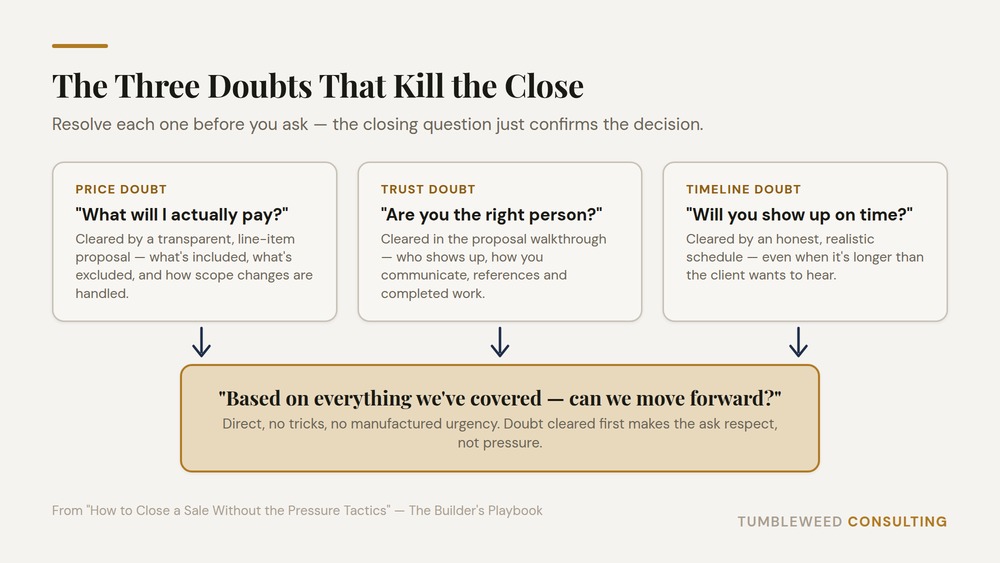
The first is price doubt: the client isn't sure the number they're looking at reflects what they'll actually pay when the job is done. This one is almost entirely solved by being specific and transparent in the proposal. Not a lump sum with vague line items, but a breakdown that makes clear what's included, what's excluded, and what the process looks like when something changes scope. A client who understands the number and trusts that it reflects reality is not the same client who hesitates at the close.
The second is trust doubt: the client hasn't fully decided whether you're the right person for this job. This is handled during the proposal walkthrough by being specific about how you work, what your crew looks like, what the communication cadence is, and what the client should expect from the experience of having you on their property. References help. Photos of completed work help. So does a track record of handling problems well — I've written about a complaint that became a five-year client, because how you respond when something goes wrong is often what convinces people you're safe to hire. All of it reduces the uncertainty that makes people stall.
The third is timeline doubt: they're not sure the schedule is real or that you'll actually show up when you say you will. This is the most underrated source of hesitation in residential work. Clients have usually been burned before by a contractor who said six weeks and meant fourteen. Give them a realistic, honest schedule, even if it's longer than what they want to hear. It builds more confidence than an optimistic number they don't believe anyway.
Losing the job in the follow-up after the estimate is almost always the result of one of these three doubts that wasn't resolved before the client went quiet. By the time they stop returning calls, the doubt has already hardened into a decision, and re-engaging becomes much harder than it would have been to address it directly during the proposal conversation.
How to Actually Ask
Once you've done the work — the discovery, the honest proposal, the doubt-clearing walkthrough — the closing question itself does not need to be complicated. Direct is better than clever. Apologetic is worse than direct.
"Direct is better than clever. Apologetic is worse than direct."
"Based on everything we've covered, I'd like to get this scheduled — can we move forward?" That's it. No technique, no trick, no pressure. A clear question from someone who has earned the right to ask it. If the answer is yes, confirm the next step and move toward deposit and scheduling. If the answer is "we need to think about it," that's your cue to ask a simple, non-aggressive follow-up: "Of course — is there anything in what we covered that you'd like to talk through before you decide?" That question gets to the real concern more directly than waiting for the client to bring it up themselves.
A defined closing step is also one piece of managing the sales gap between the estimates you send and the jobs you win. When the closing step is defined and consistent — when you know exactly what you're going to say and exactly what you'll ask if you get a soft no — you stop winging it and start building a process that compounds over time, and one that, once it's written down, someone other than you can run. Every rep makes the next one easier, and the discomfort that you feel right now is almost entirely about unfamiliarity, not about the inherent difficulty of the conversation.
The Bottom Line
Closing is not manipulation. It's a professional question asked by someone who has done the work to earn a yes. If it feels manipulative, something happened earlier in the process that made the question feel premature: either the doubt wasn't cleared, the trust wasn't built, or the proposal left too much uncertainty. Fix those things, and the closing question becomes the easiest part of the conversation.
The version of selling that makes trades people uncomfortable is the version that deserves to make them uncomfortable. The version that's actually honest — where you've done the discovery, given an accurate scope, and addressed the real concerns — is something you can do without apology, because you've genuinely earned the business you're asking for. If you want help building the kind of sales process that feels like that from the first conversation to the last, that's exactly what I work through with trades business owners in my construction business coaching.
Quick answers
How do contractors close sales without feeling pushy?
Contractors close well when they've done thorough discovery, given an accurate scope and clear pricing, and addressed the client's real concerns before asking for the decision. When doubt has been eliminated before the closing question, asking 'are we moving forward?' feels like a natural next step rather than pressure — because it is.
What is the best way to ask for the sale in construction?
The most effective way to ask for the sale is directly and without apology: 'Based on everything we've covered, I'd like to get this scheduled — can we move forward?' No manufactured urgency, no tricks. Just a straightforward question from someone who has genuinely earned the right to ask it by doing the discovery and proposal work well.
Why do trades business owners struggle with sales closing?
Most trades owners associate closing with manipulation — with pressure tactics, false urgency, and the feeling of getting something over on someone. That discomfort is valid because those tactics are genuinely bad. The mistake is connecting the discomfort with closing itself rather than with bad closing. Asking a qualified prospect for a decision is not manipulation — it's a professional service.
Get The Builder's Playbook in your inbox
A short note from Eddy with a link to the week's post — one email a week, every Thursday, nothing else.
No spam. Unsubscribe with one click any time. Privacy policy.
This site is protected by reCAPTCHA and the Google Privacy Policy and Terms of Service apply.