
Early on I priced a custom home addition on a per-square-foot number, won it, and finished it $22,000 in the hole. I've told the story of the job that cost me $22,000 before, mostly as a lesson about bad soil, a lot with no delivery access and square-foot pricing. The part I tell less often is what happened during the six weeks the permit revisions added to the schedule. While we waited, the material prices I'd built the estimate on kept moving, and when we finally ordered, almost nothing came in at the number on my quote. There was nothing in my quote or my contract that said when my price stopped being good, so every dollar of that movement came out of my margin.
I was a small operator then, and I took the hit on one job. A company with a management team and twenty jobs on the go doesn't take the hit once. It takes it on every fixed-price job that was quoted at one price and bought at another, and if nobody has decided how the company handles that, each estimator and each PM handles it their own way.
Why it's coming up now
Material prices always move, but this year they're moving for reasons nobody on your team can predict. Canada announced another round of counter-tariffs on U.S. imports in late August, effective September 8, 2026, and the Canadian Construction Association's bulletin to its members warns that steel and aluminum, including structural products, and a range of wood products are squarely in the path of it. The Independent Contractors and Businesses Association made the same point the day the measures took effect: the new tariffs land on construction's shopping list.
I'm not going to guess what happens next with trade policy, and you shouldn't build your pricing on anyone's guess either. The useful question isn't where prices will go. It's who carries the movement between the day you quote and the day you buy, and whether the company decided that on purpose.
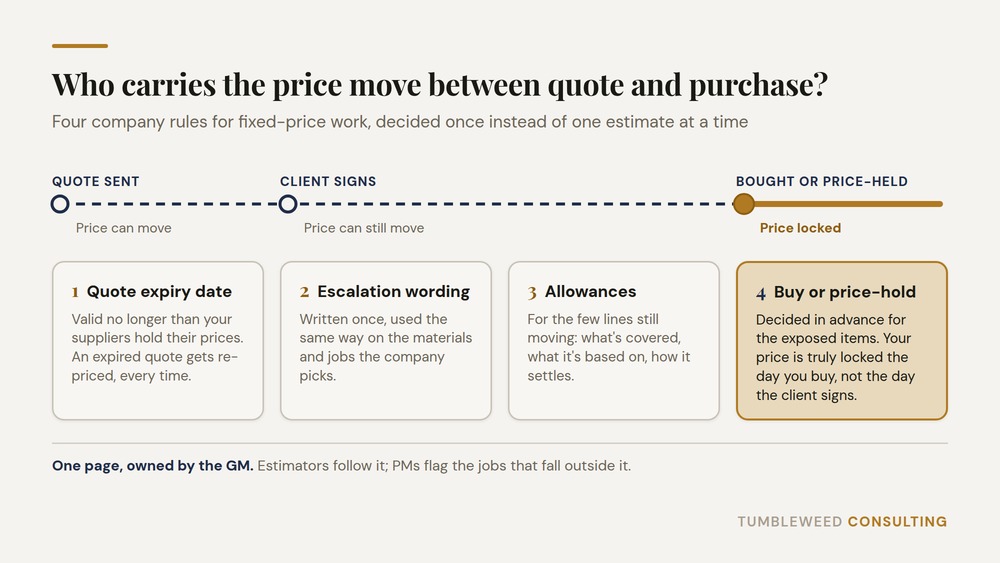
Every quote has an expiry date
The cheapest protection is the one most companies skip. Every quote that leaves the office should say how long the price is good for, and that period should be a company rule, not something each estimator types in from memory or leaves off.
The test I use for setting it is simple. Look at how long your suppliers will hold their prices to you. If your quote is valid for longer than the prices it was built on, the company is carrying risk nobody priced. On stable items that gap may not matter much. On the materials that are moving, it matters a great deal, and the validity on those lines can be shorter than the rest of the quote.
The rule also has to say what happens when a quote expires. In a lot of companies the answer is nothing; the client signs two months later and the PM honours the old number because it feels awkward to go back. An expired quote should be re-priced, every time, and the client should know that from the day they receive it.
"A quote without an expiry date is a promise to absorb whatever the market does until the client gets around to signing."
Escalation wording, written once
Some jobs run long enough that even a short quote validity doesn't help, because the material won't be bought for months. That's where price-adjustment wording comes in, and the exact wording is a contract question for whoever drafts your contracts. My point is about management, not law: the company should decide which materials and which kinds of jobs carry an adjustment provision, have the wording written once, and use it the same way every time.
What I see instead is PMs improvising. One adds a line about steel to his contract, another doesn't, a third agrees to take it out because the client pushed back. The company ends up with twenty different risk positions on twenty jobs and no one who could tell you what they are.
Whatever the wording says, the client should hear about it before they sign. The pre-construction conversation is where you explain what the price includes, what could move, and how it'll be handled if it does. A client who was told up front reacts very differently from one who finds out on an invoice.
"How much price risk the company carries is a company decision. It shouldn't be made one estimate at a time."
Allowances for what you can't price yet
Where a material or a selection is genuinely uncertain, carry it as an allowance and describe it properly: what it covers, what the number is based on, and how the difference gets settled when the real price is known. An allowance that just says "fixtures, $X" invites an argument. One that names what's included and how it reconciles gives the PM something to stand on.
Allowances aren't a way to dodge pricing work. A quote that's mostly allowances tells the client you didn't do the estimate. Used for the few lines that really are moving or undecided, they put the uncertainty where both parties can see it instead of buried in your contingency.
When to buy
The last rule is purchasing timing. On a fixed-price job, the day your price is truly locked is the day you buy the material or get a written price hold from the supplier, not the day the client signs. For the exposed items, the company should decide in advance whether they get ordered or price-held at signing, who makes that call, and how it's paid for.
That last part is the catch. Buying early ties up cash and needs somewhere to store the material, so it has to line up with your deposit and billing terms. It's also where your supplier relationships earn their keep, because a supplier who knows you and your volume is far more likely to hold a price or give you warning before it moves.
One page, owned by the GM
None of this needs a binder. It needs one page, owned by the GM or whoever runs operations, that sets the quote validity, the materials that get adjustment wording, how allowances are written and when exposed materials get bought. Estimators follow it, PMs flag when a job falls outside it, and the page gets reviewed whenever prices make a big move, which this year may be often.
The Bottom Line
You can't control what tariffs do to steel or lumber, and you won't out-guess the market. What you can control is whether your company decided in advance who carries the movement between the quote and the purchase. If that decision lives in a dozen people's judgment, the company has made it anyway, by default, and it's usually decided in the client's favour. I learned that on one addition. A company your size shouldn't have to learn it twenty jobs at a time.
If material prices are moving faster than your quotes and your contracts, I'll go through your estimating, purchasing and contract habits with your team and help you write the rules down. See how management consulting works.
Quick answers
How do contractors protect fixed-price jobs from material price increases?
With company rules rather than job-by-job judgment: every quote carries an expiry date, volatile materials get short validity or a price-adjustment provision written once and used every time, uncertain items are carried as clearly described allowances, and exposed materials are bought or price-held as soon as the contract is signed.
How long should a construction quote be valid?
Long enough for the client to decide and short enough that your supplier prices still hold. The useful test is your suppliers' own price-hold periods: a quote that outlives the prices it was built on is carrying risk nobody priced. Set the period as a company rule and re-price expired quotes rather than honouring them by default.
Are tariffs affecting Canadian construction material prices in 2026?
Yes. Canada's latest round of counter-tariffs on U.S. imports took effect on September 8, 2026, and the Canadian Construction Association has warned members about the effect on steel, aluminum and wood products. Contractors should price their quotes and contracts on the assumption that material prices can move between quote and purchase.
Get The Builder's Playbook in your inbox
A short note from Eddy with a link to the week's post — one email a week, every Thursday, nothing else.
No spam. Unsubscribe with one click any time. Privacy policy.
This site is protected by reCAPTCHA and the Google Privacy Policy and Terms of Service apply.